


Training Management
Training Management

U.S. Army Pfc. Jesus Badillo-Rendon, a military police officer assigned to the 18th Military Police Brigade, 21st Theater Sustainment Command, pulls security during battle drills for the 21st Theater Sustainment Command Best Squad Competition at U.S. Army Garrison Bavaria, Germany, April 22, 2026. The event tests Soldiers’ ability to maintain security, situational awareness, and tactical effectiveness in a demanding training environment.
(U.S. Army photo by Sgt. 1st Class Tanisha Karn)
(U.S. Army photo by Sgt. 1st Class Tanisha Karn)
The Army faces a training management challenge, particularly in the Military Police Corps, which lacks a published training strategy and defined requirements for its companies. While many leaders grasp the fundamental concepts of training management, consistent implementation remains a challenge. This issue is compounded by the limited training opportunities current company commanders and senior noncommissioned officers experienced during recent developmental assignments due to COVID-19 restrictions. A published training circular (TC)—modeled after TC 3-20.11, Training to Proficiency: Maneuver Company and Troop—would reduce subjectivity and ambiguity, giving commanders a clear framework to assess their formations and develop training guidance that meets operational readiness requirements.[i]
Field manual (FM) 7-0 identifies three categories of training proficiency: mission-essential task (MET) proficiency, qualification, and collective live fire.[ii] MET proficiency training is well understood across the force and culturally integrated within our formations. Units and leaders generally know how to train these tasks; however, issues arise when developing the training process to meet a required readiness level. First, brigade and battalion annual training guidance (ATG), if published, tends to be vague and miss key requirements outlined in FM 7-0, such as when to achieve training proficiency and the type of time management system used.[iii] These are critical factors in creating an assessable training management system that is tracked through regular training briefs. For example, if a company has a combat training center (CTC) rotation scheduled for 1 September and must arrive as a training level 2 (T2), the brigade’s task to that company in the ATG should read: “XXX Military Police Company achieves T2 no earlier than 1 June and no later than 1 August in order to deploy in support of the CTC rotation.” Clearly stating the task enables the subordinate commanders at echelon to build a training progression capable of reaching an appropriate readiness objective.

26th Military Police Detachment, 720th Military Police Battalion, 89th Military Police Brigade. Military working dogs handlers and military working dogs forge strong bonds through training and repetition creating a unique environment and a sense of partnership.
(U.S. Army photo by Spc. Patrick M. Connery)
(U.S. Army photo by Spc. Patrick M. Connery)
Additionally, many leaders struggle to understand time management. Most understand that training should be progressive and have built-in flexibility. However, the demands of planning, resourcing, training leaders, and maintaining equipment become clear only through experience. If scheduled improperly, commanders eventually increase risk by compressing training or circumventing the 8-Step Training Model. Battalions and brigades can either dictate a standardized cycle for subordinate units within the ATG or allow flexibility in choosing a suitable method—but a time management system must be required.
Qualification tasks have less widespread understanding. TC 3-20, Integrated Weapons and Training Strategy (IWTS), was published as COVID constraints reduced training opportunities across the force.[iv] A recent report from the III Armored Corps (IIIAC) Inspector General, Inspection of the Unit Marksmanship Program (FY24), identified that many leaders within IIIAC Corps demonstrate a limited understanding of the IWTS and its related publications (TC 3-20.40, Training and Qualification—Individual Weapons and TC 3-20.31, Training and Qualification—Crew).[v],[vi],[vii] The report, based on surveys of leaders across IIIAC at all echelons, identified a lack of understanding regarding the training tables required for qualification. These TCs form the foundation of unit training management. They should be emphasized during primary military education and utilized to form an outline for any unit’s annual training plan.
U.S. Army Military Police assigned to Headquarters and Headquarters Company (HHC), complete the M17 pistol portion of their Law Enforcement Weapons Training and Qualification (LEWTAQ) test at the 7th Army Training Command’s Wackernheim Regional Range Complex (WRRC), Ingelheim am Rhein, Germany, March 24, 2026.
(U.S. Army photo by VI Specialist Nathaniel Petraitis)
(U.S. Army photo by VI Specialist Nathaniel Petraitis)
The last proficiency, collective live fire, is an area in which military police units are universally lacking. At best, units conduct a limited dismounted movement to contact or convoy live fire. However, they often do so without adhering to the standards outlined in TC 3-20 or using the military police live-fire Training and Evaluation Outlines published on the Army Training Network. Collective live-fire proficiency is often overlooked in commanders’ assessments of training readiness. Leaders frequently report units as fully trained without achieving any collective live-fire proficiency gates. Observations from professional military education and after-action reviews indicate a common confusion regarding terminology. Many platoon leaders and company commanders equate qualification tables with live-fire exercises, viewing static crew qualification as equivalent to mounted machine gun gunnery qualifications. If the Military Police Corps claims the ability to defeat level I and II threats and delay level III threats, this represents an education gap that must be closed through defined training gates, education, and leadership.

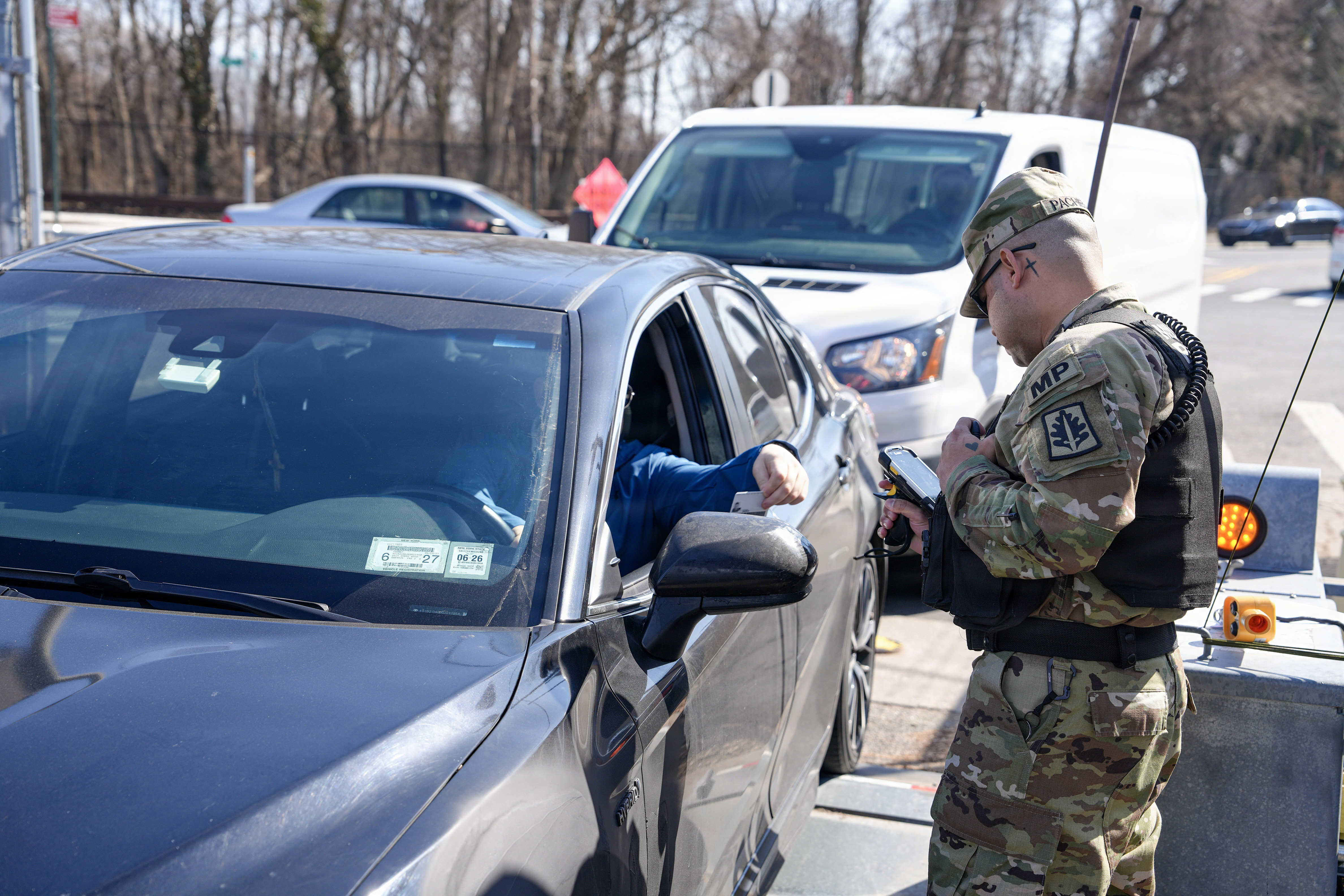
U.S. Army Sgt. 1st Class Joseph Pacheco, assigned to the 430th Military Police Law and Order Detachment from Red Bank, N.J., supports access control operations at U.S. Army Garrison Fort Hamilton, N.Y., on March 11, 2026.
(U.S. Army photo by Mark Getman, Fort Hamilton Public Affairs Office)
(U.S. Army photo by Mark Getman, Fort Hamilton Public Affairs Office)
The publication of a dedicated Military Police Corps training doctrine is critical to closing this gap. This TC would outline a comprehensive military police training strategy for all company- and detachment-level formations, enabling them to achieve fire-and-maneuver proficiency at home station. It should include the IWTS’ purpose, standard structure, and training requirements. It should also specify resource requirements—such as types and quantities of ammunition and pyrotechnics, required range types, and specialized training opportunities like Master Gunner Common Core—for companies, detachments, and law enforcement activities. The publication can provide training principles and techniques that help units build proficiency in engaging and destroying threats efficiently in any operational environment. It should also detail the planning and preparation required to execute a successful unit weapons training program.
Additionally, TC 3-20.11 provides clear definitions of proficiency ratings, enabling commanders to consistently assess unit readiness.[viii] The Military Police Corps can adopt this model to establish training proficiency levels for its various formations, providing commanders a framework for training assessments. By using this new TC to supplement IWTS, the Military Police Corps can clearly define the training gates required for companies to reach T1 through T4. For example:
• T1: The company achieves T1 after completing Table IV (field training exercise [FTX]) and all platoons complete Table VI (Live-Fire Proficiency Gate [LFPG]).
• T2: All platoons complete Table IV (FTX), and squads complete Table VI (LFPG).
• T3: Squads complete Table IV, and crews qualify through Table VI (medium machine gun [MMG]).
• T4: Any level of proficiency below these standards.
When developing the training gates, it is critical to acknowledge that most military police units are not resourced to achieve a T1 level of proficiency; therefore, a T1 rating should represent a significant accomplishment requiring additional dedicated resources. Regardless of how training levels are defined, establishing clear standards will provide a baseline to all military police units, give consistent training strategies, and still allow for flexibility to meet mission-specific requirements.
To close the education gap and enhance operational readiness, the Military Police Corps must prioritize the development of clear, standardized training doctrine. The publication of a new TC—modeled after TC 3-20.11 and providing definitive training gates and requirements for commanders—would fundamentally strengthen unit training. This level of detail is essential if the Military Police Corps is to consistently deliver the capabilities the Army demands.
About the Author
Major Noel Whitten is the Military Police Organizational Integrator for the United States Army Forces Command. He holds a master's degree in business and organizational security management from Webster University, Webster Groves, Missouri.
Endnotes:
- Department of the Army, Training to Proficiency: Maneuver Company and Troop, TC 3-20.11 (Washington, DC: Department of the Army, April 2021). ↩
- Department of the Army, Training, FM 7-0 (Washington, DC: Government Publishing Office, 2021). ↩
- Ibid. ↩
- Department of the Army, Integrated Weapons and Training Strategy, TC 3-20 (Washington, DC: Department of the Army, June 2019). ↩
- III Armored Corps Inspector General, Inspection of the Unit Marksmanship Program (FY24) (Fort Cavazos, TX: III Armored Corps, 2024). ↩
- Department of the Army, Training and Qualification – Individual Weapons, TC 3-20.40 (Washington, DC: Department of the Army, July 2019). ↩
- Department of the Army, Training and Qualification – Crew, TC 3-20.31 (Washington, DC: Department of the Army, March 2015). ↩
- Department of the Army, Training to Proficiency: Maneuver Company and Troop, TC 3-20.11 (Washington, DC: Department of the Army, April 2021). ↩
Disclaimer 1: The contents of this article do not represent the official views of, nor are they endorsed by, the U.S. Army, the Department of War (DoW), or the U.S. Government.
Disclaimer 2: This article was edited with the assistance of AI tools, and subsequently reviewed and edited by relevant Department of War (DoW) personnel to ensure accuracy, clarity, and compliance with DoW policies and guidance.