


Targeted and Exposed: Why Command Post Survivability Demands a Paradigm Shift
Targeted and Exposed:
Why Command Post Survivability Demands a Paradigm Shift

(AI Generated Graphic)
Introduction
Modern Army Aviation command post (CP) survivability demands a shift from legacy practices rooted in counterinsurgency (COIN) operations to agile, dispersed, and low-signature configurations. Drawing lessons from the Russo-Ukrainian War, this article emphasizes the need for mobility, CP design modularity, CP dispersion, and emissions control (EMCON). The protection warfighting function takes primacy in the survivability of CPs, aviation assets, and structures. The role that aviation plays in threat engagement, reconnaissance, logistics, and sustainment warrants a sober conversation in how to ensure the mission set is enhanced and protected. It highlights the importance of doctrinal relevance to mirror the current and emerging threat picture, mission command, and decentralized operations to enhance resilience against near-peer threats.
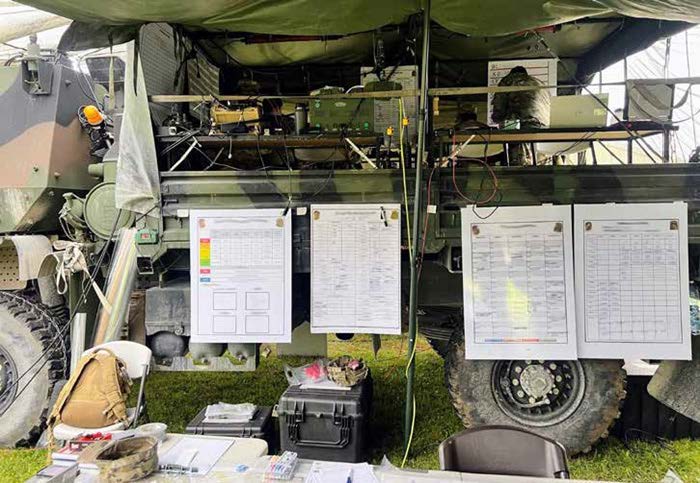
Units training at the JMRC locate their CPs in the back of tactical vehicle.
(Photo by SFC Samuel K. Karoki)
(Photo by SFC Samuel K. Karoki)
Modernizing CP Survivability (Limitations)
A young commander eagerly tells an experienced 1SG, “1SG, we are going to transform the Shop Equipment Contact Maintenance into the Company Delta command post…” The 1SG mulls it for a moment and retorts in monotone, “Ma'am, I think we need to set up at least one A-frame tent.” This is a classic Einstellung effect, a bias that hinges on familiar solutions as opposed to the exploration of different possibilities.[1] A limitation is created when you have rigid deference to experience in informing solutions to new problem sets. It can be a deterrent to adopting new ideas in response to the rapidly evolving threat landscape and near-peer adversary capabilities. There appears to be a resistance to shedding the COIN mindset, where the grand “Taj Mahal” setup of command posts (CPs) littered a unit’s footprint. This viewpoint is informed by observations made during multiple rotational training units going through their Combat Training Center (CTC) rotation at the Joint Multinational Readiness Center (JMRC) at the Hohenfels, Germany, training area.
The vestiges of COIN are evident in how units train and conduct operations during these CTC rotations at JMRC. Observer, Coach/Trainers (OC/Ts) at the CTCs must coach units to adopt doctrine-based practices that match current and emerging threats. Observations inform the OC/Ts’ evaluation of a unit, and heavy coaching is needed to expand their aperture so they can be postured to execute novel, but doctrinally-based techniques and procedures. That responsibility requires that OC/Ts be well-versed in the doctrine that advises their coaching content.
Lessons Learned
Aligning tactical and operational procedures with high-intensity conflict readiness requires training and implementation at various echelons. Units assume strategic liability when they employ COIN-optimized tactics to train for large-scale combat operations (LSCO). These tactics are outdated when overlaid against the backdrop of recent conflicts. Lessons from the Russo-Ukrainian War’s tactics and challenges are driving changes in the United States Army’s tactical operations and security posture. Command post survivability is a recurring theme of these lessons learned and is critical because it is the command and control (C2) node.
Mobility
Aviation CP survivability critically hinges on the ability to be mobile, highly camouflaged, and rapidly deployable. The CP needs to be small to minimize the unit's signature, quick to tear down, and move at a moment's notice. The prevalence of detection capabilities, such as electromagnetic spectrum signature detection, heat sensors, and the massing of reconnaissance drones necessitates mobility and rapid displacement. Units training at the JMRC are locating their CPs in the back of tactical vehicles and seeking concealment in heavily wood-ed areas. These include the Light Medium Tactical Vehicle (LMTV) variants, such as the M1079 LMTV van and the M1087 MTV expandable van. This reduces visual detection but also complicates establishing a reliable communication signal due to thick foliage.

(AI Generated Graphic)
CP Design Modularity
The Army is working on a solution to enhance CP mobility called CP Modernization (CPMod). At its core, CPMod is about mobility, survivability, and adaptability. The focus is on modular designs that units can tailor to their mission and terrain.[2] Command post Mod’s tailorable CP configurations support modular aviation support packages. These modular packages should include mobile maintenance shelters with integrated secure communication capabilities, parts, and fuel that can extend the range of rotary aircraft. Collocating mobile modular packages with aircraft in hardened structures enhances maintenance continuity, survivability, and addresses the exposed aircraft parking Army Aviation is so accustomed to. These hardened maintenance modules could be repurposed industrial buildings, tunnels, or underground bays used as forward maintenance zones.
CP Dispersion
“Future CPs must be smaller, more mobile, and more capable of operating in dispersed mode—and preferably on the move as well. The CPs of the future also must employ advanced signature modifications, emissions controls, and state-of-the-art cybersecurity” (Goure, 2023).
According to Army Techniques Publication 6-0.5, Command Post Organization and Operations, “Survivability is often obtained at the price of effectiveness”[3] This should be executed with proper regard to preserving combat effectiveness. Mission command has previously relied on collocation to enable synchronized lines of effort. Dispersion can disrupt that synchrony and consequently, degrade C2 if not deliberately trained and executed, resulting in CP survivability without combat effectiveness.
Ukrainian CPs are often characterized by geographical dispersion, autonomy, and redundancy. Commanders must empower subordinate commanders to exercise disciplined initiative and make decisions within the commander’s intent without fear of reprisal. Army Doctrine Publication 6-0, Mission Command, dictates that mission command requires commanders to issue mission orders. Mission orders are “directives that emphasize to subordinates the results to be attained, not how they are to achieve them”[4]
Army Aviation would benefit from mobile, decentralized, and autonomously operated distributed maintenance nodes geographically dispersed from primary CPs to enhance operational resilience. The maintenance nodes will have to integrate logistics and maintenance planning into their operations. Since they are autonomous, they will need to communicate needs for resupply. This autonomy enhances logistics agility in LSCO and aircraft readiness in contested, sensor-saturated environments.
EMCON
“Command and Control (C2) nodes are an example of High-Value-Targets (HVT) targeted by adversary doctrines … mobile SIGINT [signal intelligence] collectors locate command nodes, UAS [unmanned aircraft systems] confirm the target location, and artillery at echelon execute massed fires strikes before blue force commanders can react”[5]
Lessons from the Russo-Ukrainian War reveal that the large thermal, acoustic, and electromagnetic signatures emitted by communications equipment and generators threaten operational security. Units must plan and train for degraded communications within EMCON standard operating procedures. Emission control coaching by the Falcon Team, JMRC, emphasizes redundancy by developing analog products alongside digital ones in the event of degraded communications. A North Atlantic Treaty Organization (NATO) aviation unit successfully employed EMCON techniques while at JMRC. They did this by running analog telephone lines between CPs to communicate and burying their generator exhaust hoses underground, while also limiting use to reduce their thermal signature.
The prevalence of communication systems, generators, and static life-support equipment was a mainstay during COIN operations against a technologically inferior enemy. A near-peer enemy capable of multidomain operations, like China, has detection and jamming capabilities that would enable precision targeting based on emissions. Techniques to control this include burying or berming generators, employing noise dampening, using camouflage netting, and limiting how long they are kept running. The NATO aviation unit also placed restrictions on the use of personal electronic devices, specifically prohibiting phones with non-central European subscriber identity module, or SIM, cards. A vulnerability exists as they do not blend in with the local economy, as observed through mobile SIGINT collectors. Rotational training units at JMRC have been adopting the “no/limited cell phone policy” to minimize a unit’s signature.
Conclusion
Command post survivability is not just a technical challenge; it is a cultural one. Leaders must challenge legacy mindsets, empower disciplined initiative, and train to operate under degraded conditions. Threat analysis must drive offensive and defensive responses across multiple domains. Strategy and tactics are rapidly evolving and so should aviation units, if they are to survive the onslaught that awaits against a near-peer multidomain enemy. The end state is to effectively project combat power while remaining survivable. Recent changes in US Army operations and structuring, to include investments in future technology, points to the fact that the way we used to do things demands a paradigm shift.
About the Author
SFC Samuel Karoki is a highly accomplished Army Aviation Noncommissioned Officer with more than 15 years of experience shaping aviation excellence across US Army Forces Command, US Central Command, the Army Transformation and Training Command (formerly Training and Doctrine Command), and NATO-aligned forces. He now serves as an OC/T with Falcon Team at JMRC, where he evaluates aviation units on mission-critical tasks, including Downed Aircraft Recovery, battle damage assessment and repair, and survivability.
Endnotes:
- The Decision Lab. (n.d.). Why do our past experiences prevent us from reaching the best possible outcome? https://thedecisionlab.com/biases/einstellung-effect. ↩
- Goure, D. (2023, September 5). Lessons from Ukraine: Command posts must be more agile. 1945. https://www.19fortyfive.com/2023/09/lessonsfromukrainecommandpostsmustbemoreagile/. ↩
- Department of the Army. (2017). Command post organization and operations (Army Techniques Publication 6-0.5). https://armypubs.army.mil/epubs/dr_pubs/dr_a/pdf/web/atp%206-0_5%20(final).pdf ↩
- Department of the Army. (2019). Mission command (Army Doctrine Publication 6-0). https://armypubs.army.mil/epubs/dr_pubs/dr_a/arn34403-adp_6-0-000-web-3.pdf. ↩
- Dolan, P. (2025, July). Like moths to a false flame: Lethality and protection through deception operations. US Army. https://www.army.mil/article/286861/like_moths_to_a_false_flame_lethality_and_protection_through_deception_operations. ↩
Disclaimer 1: The contents of this article do not represent the official views of, nor are they endorsed by, the US Army, the Department of War, or the US government.
Disclaimer 2: Originally published March 10, 2026 in the Winter 2026 edition of the Aviation Digest; reprinted with permission.