Published 12/5/2024 First Lieutenant Addison S. Sanders
Role of the 52d BEB CBRN R&S Platoon
After 70 years, the ever-present and reputable chemical, biological, radiological, and nuclear (CBRN) threat continues to mire U.S. forces throughout the Indo-Pacific Command. The 13th Korea Rotation Force (KRF-13), Camps Casey/Hovey, Republic of Korea, works to deter the proliferation and employment of CBRN munitions by adversaries. At the tactical level, a variety of CBRN units—most notably, the mounted CBRN Reconnaissance and Surveillance (R&S) Platoon, 52d Brigade Engineer Battalion (BEB), Fort Carson, Colorado—are responsible for assessing, mitigating, and protecting against CBRN hazards.
KRF-13 includes the 2d Stryker Brigade Combat Team, 4th Infantry Division, Fort Carson, which contains one organic CBRN platoon—the 52d BEB CBRN R&S Platoon. The CBRN R&S Platoon provides early warning detection against CBRN threats via route, area, and zone reconnaissance and surveillance. In other words, the R&S Platoon acts as the first line of defense through assessment, mitigation and prevention of CBRN threats.
The 52d BEB CBRN R&S Platoon is known for its M1135 Nuclear, Biological, and Chemical Reconnaissance Vehicles (NBCRVs) and associated hazard assessment skills. The platoon maintains the unique ability to provide early warning of CBRN agents by detecting and marking CBRN hazards through mounted surveys, surveillance, and sampling and preventing the spread of contamination. Moreover, the CBRN R&S Platoon is an essential enabler in protecting follow-on maneuver force missions.
M1135 NBCRV Maintenance
KRF-13 maintains three NBCRVs that belong to the Korean Enduring Equipment Set, meaning they remain on the Korean peninsula despite unit rotations. Upon assuming KRF-13, the 52d BEB CBRN R&S Platoon determined that these vehicles required extensive repair and countless hours of persistent maintenance. Through their perseverance, the R&S Platoon Soldiers achieved full NBCRV mission capability, which was key in conducting training and maintaining “Fight Tonight and Win” readiness in Korea. 52d BEB CBRN R&S Platoon Soldiers occupy four key troop positions in each of three NBCRVs; the driver, vehicle commander, surveyor, and assistant surveyor all maintain vital roles and responsibilities during R&S Platoon missions. Each NBCRV position is complex and requires a vastly different skill set. To ensure success, the R&S Platoon began its training progression in Korea by implementing individual task completion related to each position in the NBCRV.
Mission-Essential Training
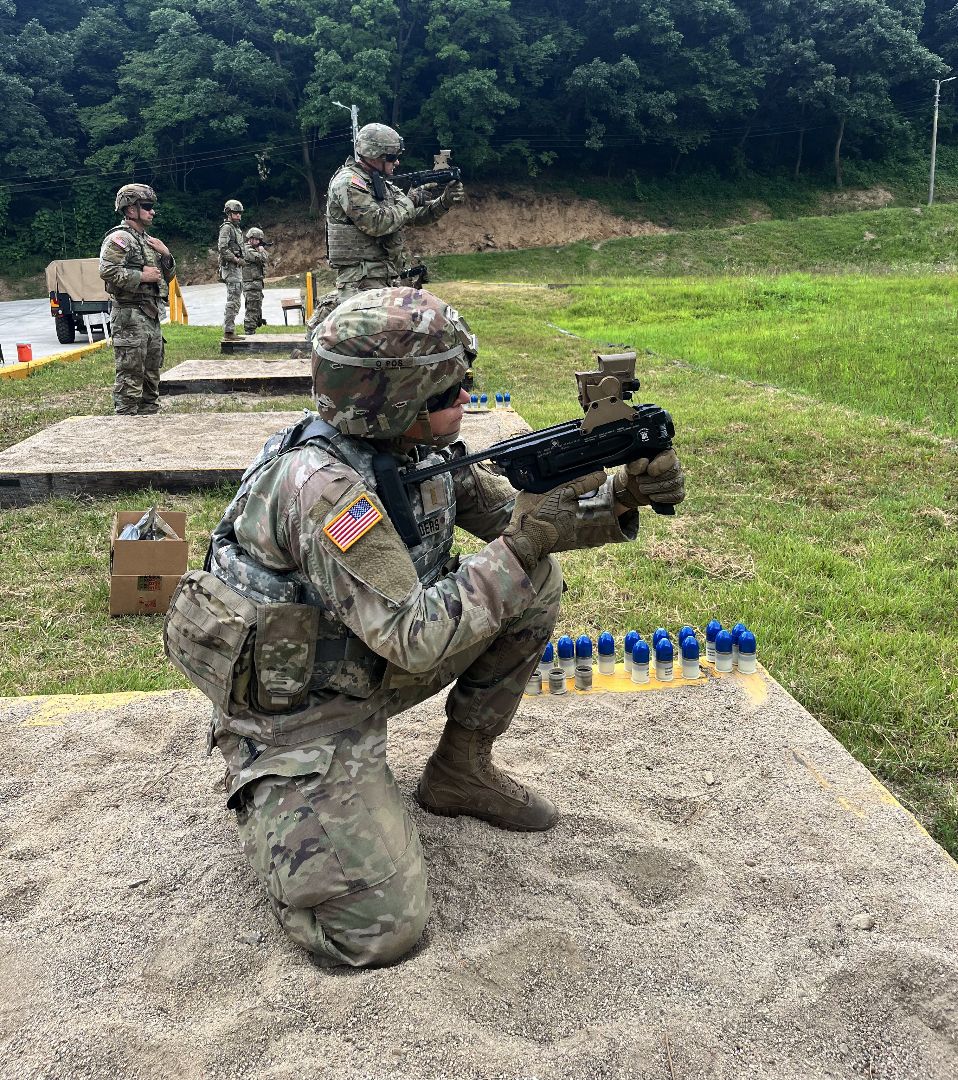
In order to maintain readiness to “Fight Tonight and Win,” the 52d BEB CBRN R&S Platoon conducted several individual, collective, and combined training exercises. Starting the rotation with individual skill acquisition, the Soldiers participated in individual weapons training during the battalion M4, M320, and M249 ranges at Apache Range, Camp Casey. Driving, marking, sampling equipment operation, and sensor management were among the many essential individual skills that were trained by the 52d BEB CBRN R&S Platoon during the early months of the rotation. Skills were taught by Additional Skill Identifier L6-qualified platoon members in a classroom setting with subsequent hands-on practice. In preparation for field exercises, Soldiers practiced collecting liquid and soil samples from the over pressured protection of the NBCRV. Sample tasks, and individual task proficiency contributes to the ability of the platoon to function as a team. After weeks of individual training, the CBRN R&S Platoon conducted a series of collective training exercises on Camp Casey and at Rodriguez Live-Fire Complex, Pocheon, Republic of Korea. These platoon-focused training events improved coordination among NBCRV crew positions. As the surveyors gained proficiency in collecting samples, other platoon members learned to perform tedious sample packaging procedures. Depending on the nature of the hazard (biological or chemical), they practiced packaging air, liquid, soil, and vegetation samples. In addition to collecting and packaging samples, platoon members marked contamination and the assistant surveyor completed documentation to enable sample transfer.
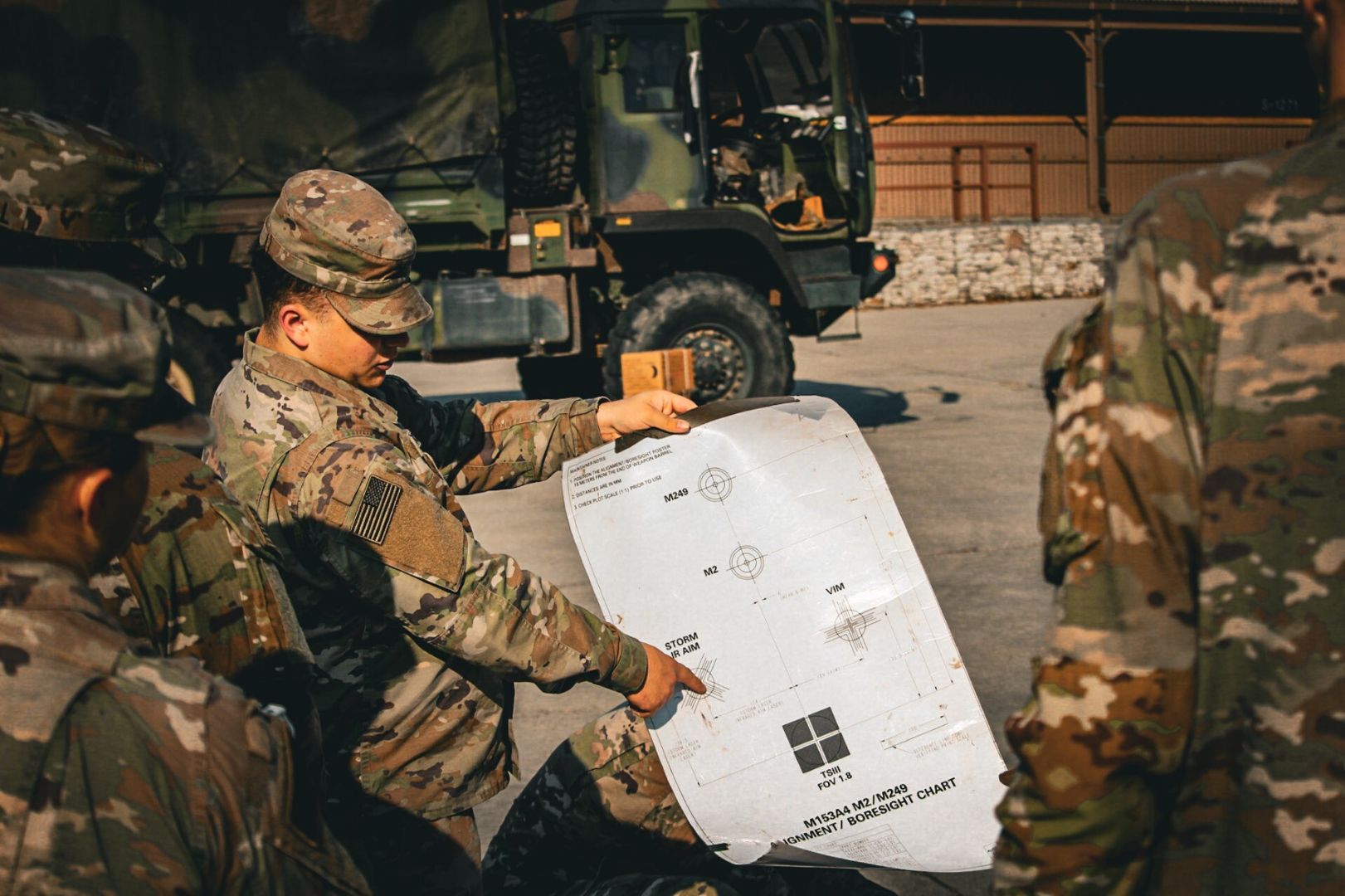
In combat, the lives of Soldiers and follow-on forces depend on the ability of the CBRN R&S Platoon to identify contaminated environments and reduce the spread of hazards. The R&S Platoon assumes the enormous responsibility of entering unknown CBRN-contaminated areas; locating, surveying, collecting, and packaging samples; and marking and reporting hazards ahead of the arrival of other units. To maintain security within the platoon during these missions, each vehicle commander has control of a .50-caliber M2A1 machine gun that is a portion of the rotating weapons system mounted atop the NBCRV. During 52d BEB Mounted Machine Gun Qualification 23 at Rodriguez Live-Fire Complex, the vehicle commanders and drivers gained proficiency in bore sighting, loading, and shooting the M2A1. One of the CBRN R&S Platoon crews achieved the best score and another the third-best score in the battalion. Demonstrated weapon proficiency is just as important as the ability to maintain CBRN technical skills when CBRN R&S platoons are operating in contested environments.
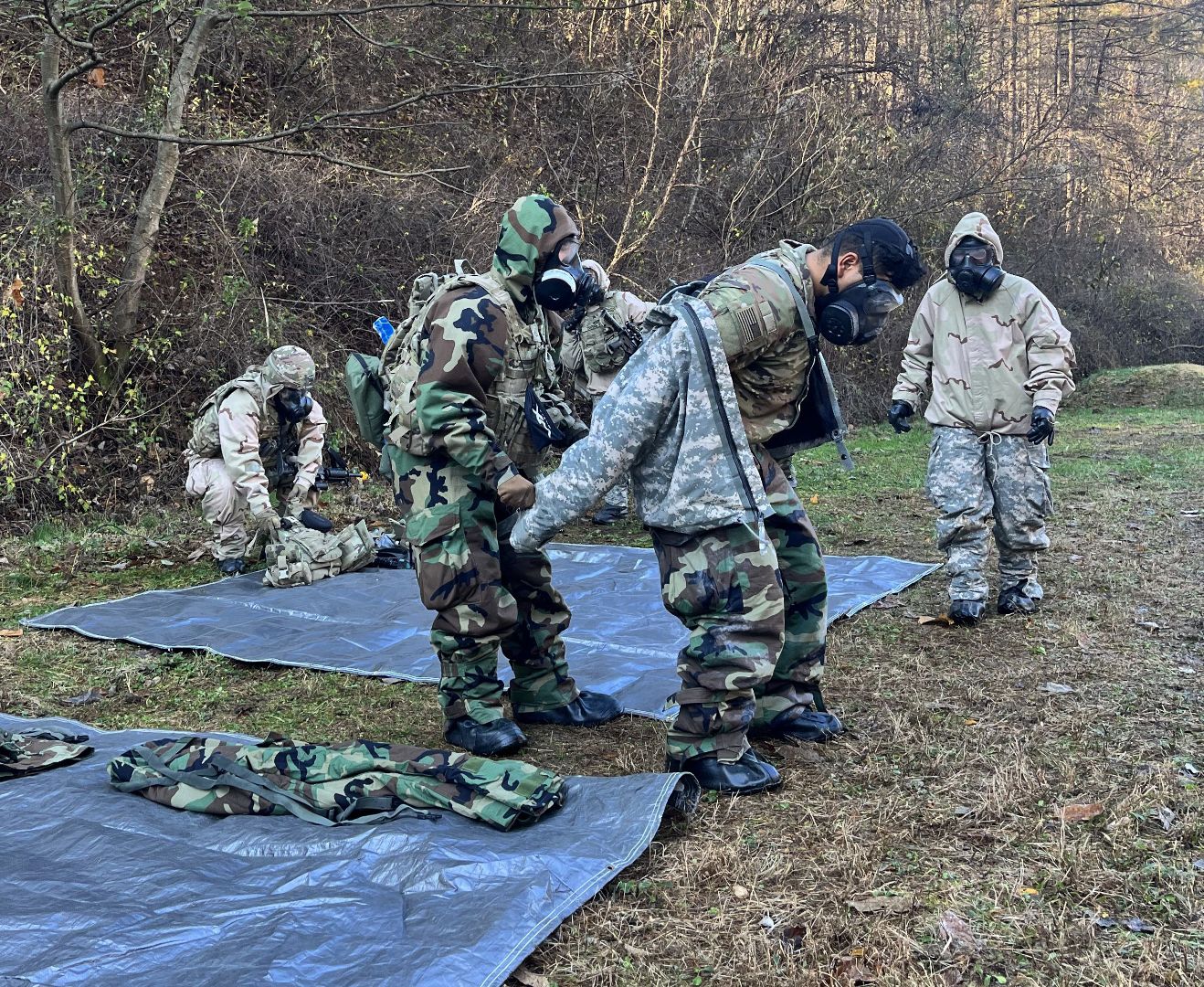
Following individual and collective training, the CBRN R&S Platoon trained on more complex scenarios, such as those involving collective reconnaissance missions. Along with practicing Battle Drill 1 (React to Contact), the platoon reviewed tactical combat casualty care drills and recovery operation steps to prepare for challenging missions. Moreover, the Soldiers practiced recovery operations in Mission-Orientated Protective Posture (MOPP) 4 personal protective equipment to simulate a realistic mission scenario. (In the case of an intravehicular casualty, crew members must be able to assess the casualty; assume the appropriate MOPP level, if necessary; and in some cases, transport the casualty to the nearest casualty collection point.)
The final phase of 52d BEB CBRN R&S Platoon training prior to integration with other units involved conducting mock mission operations with all three M1135 NBCRVs. The platoon participated in a 59th Chemical Company, Fort Drum, New York, field training exercise at Rodriguez Live-Fire Complex to prepare for its platoon level training validation. While integrating, for the first time, with an adjacent CBRN NBCRV platoon, the Soldiers of the 52d BEB CBRN R&S Platoon reviewed all individual and collective tasks. They observed varying technical execution between the two platoons, made external connections with the 59th Chemical Company, and adjusted their tactical standard operating procedures. The platoons focused on coordinating locate-and-surveying pattern techniques between adjacent crews to practice quickly covering complex terrain. The field training exercise was essential in honing readiness. Most importantly, reviewing platoon level tasks built team cohesion and prepared Soldiers for combined training exercises with the 23d CBRN Battalion, Camp Humphreys, Korea.
Combined Training Exercise
demonstrated platoon level task proficiency, they were evaluated during a combined validation exercise with the 23d CBRN Battalion and partnered Republic of Korea–Army (ROKA) Soldiers. The 23d is the permanent-party CBRN battalion in Korea, and it has operational control of various CBRN units, including hazard assessment, reconnaissance and surveillance, explosive-ordnance disposal, R&S, and technical escort units. Unlike the R&S platoons within Stryker brigade combat teams, these 23d CBRN Battalion units experience frequent training opportunities with adjacent CBRN platoons. Fortunately, the 52d BEB CBRN R&S Platoon had the unique opportunity to participate in a training exercise and increase its lethality to “Fight Tonight and Win.”
Due to the nature of large-scale combat operations, CBRN R&S platoons are always the first CBRN units in the fight and they conduct reconnaissance of hazards that may eventually become the responsibility of other CBRN platoons. This concept was incorporated into the culminating validation exercise. The 52d BEB CBRN R&S Platoon required support for the exchange and decontamination of MOPP equipment following its area, route, and zone reconnaissance missions. This training opportunity boosted the ability of the R&S Platoon and the 23d CBRN Battalion to work together to synchronize challenging technical tasks. As the validation exercise continued, the CBRN R&S Platoon successfully demonstrated proficiency with 14 platoon level mission-essential tasks, as validated by an external examiner, who affirmed the CBRN R&S Platoon training progression and ability to coordinate with various units over the course of the rotation.
Training with external units is important in maintaining interoperability with adjacent CBRN units, including ROKA chemical units. Such training increases the capability of units across the Korean peninsula and enables higher headquarters to be prepared to fight and win in CBRN-contested environments. Although, due to Army structure, the future of the 52d BEB remains uncertain, the CBRN R&S Platoon will continue to be a vital brigade reconnaissance asset, protecting maneuver forces at the forward line of troops.
Cultural Immersion
While mission-essential task training remained the 52d BEB CBRN R&S Platoon priority, the platoon recognized the importance of South Korean cultural immersion under the “We Go Together” initiative of U.S. Forces Korea, the 8th Army, and the 2d Infantry Division. Platoon leaders offered the Soldiers opportunities to learn about the U.S. Army’s role in the conflict on the peninsula and the culture of South Korea.
The CBRN R&S Platoon conducted several cultural-immersion trips to increase understanding and enhance team building, both internally and with its partner force. The first outing included a trip to the Korean War Memorial, Yongsan-dong, Yongsan-gu, Seoul, South Korea, which offered an opportunity to remember the Soldiers who fought in the Korean War. The event also enabled Soldiers to learn about various weapons systems and equipment previously used by the North Korean People’s Army, which provided insight into what a future fight could entail.
Following the trip to the Korean War Memorial, CBRN R&S Platoon Soldiers had the opportunity to meet with two North Korean defectors—a North Korean army general and his daughter—who relayed accounts about the North Korean way of life and the limitations to personal liberties experienced by the North Korean people on a daily basis. Reflecting on the stories of the North Korean defectors and on their own lives, the Soldiers began to recognize what freedom really meant to them and they reinforced their commitment to service.
After supporting an 8-week-long U.S. Forces Korea level security force mission, the CBRN R&S Platoon was offered one final opportunity for cultural immersion prior to redeployment. With the help of Korean Augmentation to the U.S. Army personnel, the 52d BEB chaplain, and a ROKA expert, the Soldiers visited the 3d Division, ROKA, area of operations at the Demilitarized Zone; this included a tour of the tunnel that North Korea had constructed to move forces into South Korea. Platoon members also observed the North and South Korean flags on the demarcation line and walked through an artifact museum. By the end of KRF-13, the CBRN R&S Platoon had gained a deeper understanding of the efforts they support as members of the U.S. Army and the global significance of their protection of South Korea.
The role of the 52d BEB CBRN R&S Platoon in M1135 NBCRV maintenance, training progression, and cultural immersion set the standard for future rotational CBRN R&S platoons on the Korean peninsula. The successful performance of the platoon provides assurance that the Korea Rotational Force is ready for the fight tonight and instills hope for units to come. In the meantime, the CBRN R&S Platoon will fight for excellence in its next adventure.
Five Deuce—CBRN R&S Platoon Leads the Way!
First Lieutenant Sanders is a CBRN R&S Platoon leader, 52d BEB, deployed in support of KRF-13. She holds a bachelor’s degree in physiology from Southern Illinois University–Carbondale.