





History of the 3rd Infantry Division
On 21 November 1917, the Third Division was activated and commanded by Major General Joseph T. Dickman. After four months of training under harsh weather conditions at Camp Greene, North Carolina, the division deployed to France as part of the American Expeditionary Force. The Third Division’s first test in combat came when the Germans launched their third spring offensive assault on Chateau-Thierry. Under the command of the French 10th Colonial Infantry Division, the division prevented the Germans from capturing the city and continuing their march towards Paris. It was during the “Second Battle of the Marne” on 15 July 1918, that the Third Division showed the world how Americans fight. Over the next three days, the 38th Infantry Regiment encountered sporadic attacks without allowing the German 10th and 36th Infantry Divisions to break through the division’s sector, thus preventing the German Army’s passage across the Marne River through Surmelin Valley. At war’s end, the Third “Marne” Division fought on the front line for 99 days and earned its first two Medal of Honor recipients, along with six campaign clasps (Aisne, Champagne-Marne, Aisne-Marne, Saint-Mihiel, Meuse-Argonne, and the Defensive Sector). Eight months after the war ended and their occupation in Germany completed, the division began to return home. In late 1939, twenty-two years after being activated, the division went through a major overhaul that saw old units inactivated and new units activated into the division, and two years later it was redesigned as the Third Infantry Division.
After the attack on Pearl Harbor, the division relocated to Fort Ord, California, several months later was transferred to Camp Pickett, Virgina. In the autumn of 1942, the division shipped out from Norfolk, Virginia, as part of the invasion force in North Africa. During World War II, the division was the only U.S. division to engage the German Third Reich on every front of the European Theater. Beginning with North Africa, then Sicily, onto and up the boot of Italy, through Southern France, over to Germany, and finally into Austria. As the war came to an end in Europe, the Third Infantry Division was considered one of the most experienced combat divisions in Europe. Through all of this, the division served over 30 months in theater with 536 days in combat, conducted four amphibious assault landings, earned ten battle streamers, a Presidential Unit Citation and the French Croix de Guerre with palm (both for Colmar Pocket). During the war, the division earned forty-four Medal of Honor recipients (the most of any division during war), including one 5-foot, 5-inch, 110-pound Soldier from tiny Texas town, Audie Leon Murphy, who would go on to be the most decorated American Soldier of World War II. After the surrender, the division remained in Germany as an occupation force headquarters at Bad Wildungen until August 1946.
The Third infantry Division returned from Germany and arrived at Fort Benning to begin its inactivation by the Army. With the unexpected invasion of South Korea by the North Korean People’s Army in June 1950, the division’s inactivation was canceled. The division was requested for service in Korea, because of its extensive combat experience during WWII. By the time the division arrived in Korea in November 1950, both the Chines Communist and North Korean Armies has combined forces and were pushing the Allies off the Korean Peninsula. The 3rd Infantry Division Arrived at the port of Hungnam, and the division’s Task Force Dog fought inland to clear a passage and hold a fragile perimeter in the hills above the city for the retiring X Corps. From 30 November until 24 December, division conducted the most colossal beachhead evacuation in American military history – 100,000 troops and 125,000 South Korean refugees. Then, as truce talks drew to a close in 1953, small unit actions were taking place along the Main Line of Resistance (MLR), as opposing forces attempted to seize tactically advantageous positions. One of these positions was Outpost Harry, a strategic outpost in the Cheorwon Valley that protected the MLR and Kumwha Valley. For eight nights in June, the Chinese Communist Army made determined attempts to overrun 15th Infantry Regiment and a tank platoon but were repelled every day. During the “Forgotten War,” the Marne Division earned thirteen Medal of Honor recipients, eight campaign streamers, two Republic of Korea Presidential Unit Citations, and the Greek gold medal for Bravery.
As tensions between the Warsaw Pact Nations and NATO increased in the 1950s, the battle-hardened 3rd Infantry Division was re-stationed in Germany from 1958 until 1996 as the first line of defense against Soviet Union aggression in Europe. In 1961, when East Germany built the Berlin Wall, it was the division that moved through East Germany to confirm their right to supply West Berlin. The next armed confrontation between democracy and communism occurred in Vietnam. While other Army divisions went into the steaming jungles, the Marne Division stood watch in Europe. With the fall of the Berlin Wall and our victory in the Cold War, the end of an era was upon us as new threats emerged in both the Middle East and Europe.
In 1990, Iraq occupied Kuwait. The tiny ally in strategic Middle East was held hostage by a brutal dictator. Once again, the division came to the defense of those who were unable to defend themselves. In 1991, 3rd Brigade of the 3rd Infantry Division was called to action in Operations Desert Shield/Desert Storm as the lead element of 1st Armored Division, rapidly destroying all opposition. As part of the United Nations in the Balkans in 1994, the division assumed a significant role in a multinational peacekeeping force in Macedonia, Bosnia-Herzegovina, and Kosovo over the next eight years. Then in 1996, after thirty-eight years of service on the frontlines in Europe, the division returned to the United States.
The division replaced the 24th Infantry Division at Fort Stewart and Fort Benning, where it served as the “Iron Fist” of the XVIII Airborne Corps. On 11 September 2001, war came to America as Al-Qaeda terrorists attacked the World Trade Center and the Pentagon. On 21 March 2003, the division began combat operations that stunned the world with its incredible lightning ground assault from Kuwait to Baghdad (four hundred miles in twenty-one days) during Operation Iraqi Freedom. Once again, the division showed the world its might as M1 Abrams Tanks and Bradley Fighting Vehicles from 2BCT stormed Baghdad International Airport and streets of Baghdad (both Thunder Runs). It was at Baghdad International Airport that SFC Paul R. Smith was posthumously awarded the Medal of Honor for his actions against an overwhelming force of Republican Guard Soldiers (the first MoH recipient of GWOT). The division would return to Iraq in 2005 and over the next year, took command of the Multi-National Division-Baghdad, which was responsible for the city’s safety. The challenging work that the division did in Baghdad and in the North created secure conditions for the election and installation of Iraq’s first democratically elected national government. Then in 2007, the division deployed to Iraq for fifteen months as part of President Bush’s “surge” of troop levels. During this period, the division conducted twelve major combat operations jointly with the Iraqi Forces, the sons of Iraq, and other Coalition forces. During Operation New Dawn in 2009, the division became the only division to serve four combat tours in Iraq. Then in 2021, the Medal of Honor was posthumously bestowed upon SFC Alwyn Cashe for his heroic action after his Bradley Fighting Vehicle hit an improvised explosive device (IED) and the subsequent retrieval of six Soldiers and an Iraqi interpreter from the burning vehicle. Then in 2021, the Medal of Honor was posthumously bestowed upon SFC Alwyn Cashe for his heroic action after his Bradley Fighting Vehicle hit an improvised explosive device (IED) and the subsequent retrieval of six Soldiers and an Iraqi interpreter from the burning vehicle.
Less than a year later, the mission objective in Iraq shifted from combat operations to stability and advisement. At the same time, in late 2009, the division’s attention turned from Iraq to Afghanistan, with the 3rd Combat Aviation Brigade becoming the first brigade in Afghanistan, followed by elements within the division in 2010. Elements of the division would return to Afghanistan in 2012, 2013, 2015, and 2017.
1ABCT deployed to Europe in support of Operation Atlantic Resolve for two years beginning in 2016, then two nine-month rotations to Korea in late 2018 and late 2020, and then in early 2022, rotated to Europe as a show of force against Putin’s invasion of Ukraine. 2LIB deployed several times to Africa, and in 2017, the brigade transferred back to an ABCT and deployed to Europe in support of operation Atlantic Resolve in 2020s.
Over the last year elements from Division HQ, 2ABCT, 3CAB, DIVARTY, and 3DSB successfully deployed to Europe in support of our NATO Allies and partners. 1ABCT validated their readiness at NTC as they prepare to deploy to Europe to defend NATO’s eastern flank. The 3ID continues to execute tough, realistic training, ready for any future mission

The Third Infantry Division shoulder patch is a square field of blue containing three diagonal white stripes with an Army green border. The blue field symbolizes the loyalty of those who placed their lives on the altar of self-sacrifice in defending the American ideals of liberty and democracy. The three white stripes of the insignia are symbolic of the three major operations in which the Division participated during World War I through the signing of the Armistice. They were the Aisne-Marne, St. Mihiel, and the Meuse-Argonne. The idea for the insignia originated with Brigadier General Preston Brown, who commanded the Division during the Meuse-Argonne Offensive.

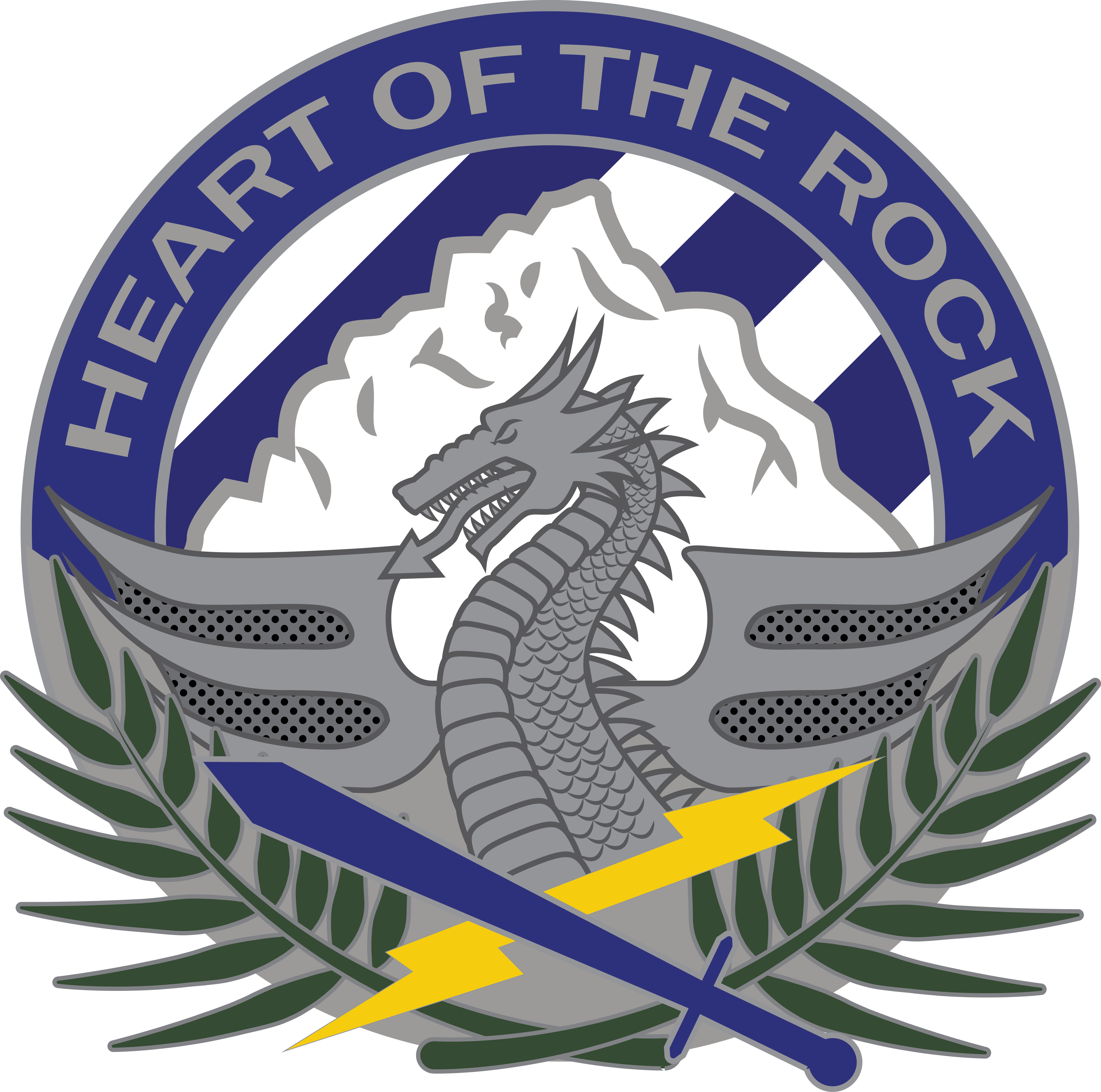
The rock, inscription, and wyvern refer to the two designations by which men of the Third Infantry Division are popularly known: “Marne Men” and “Blue and White Devils.” The rock represents the Division’s firm stand against the German offensive at the Marne River during World War I. It was there that it became known as the “Rock of the Marne” and there that the Commanding Officer, General Joseph Dickman, stated “Nous Resterons La” (We Will Stay There). The wyvern, a heraldic form of the devil, bears the Division’s blue and white stripes on its wing in commemoration of the Division’s action at Anzio, Italy, during World War II where they were called “Blue and White Devils” by the enemy.

Created by Walt Disney in 1965 after the Division's commander requested a mascot to represent the "Dogface Soldier". The design symbolizes the division's grit, toughness, and fighting spirit. Rocky's name honors the division's World War I nickname, "Rock of the Marne". For more information Click Here

3RD ID SONG: “Dogface Soldier” was written in 1942 by Cpl. Bert Gold and Lt. Ken Hart and adopted by General Truscott as the 3ID song. It became popular with the troops and gained wider recognition through the 1955 film To Hell and Back, which starred Audie Murphy. The song's success in To Hell and Back led to the sale of over 300,000 copies, making it the most well-known song from the World War II era. Listen to the Dog Face Soldier Song.