Skip to content

Navigation Menu

About

  • Mission and Vision
  • Leadership
  • History
  • Fort Leonard Wood Historic Tour
  • FLW Command Policies and Memorandums of Instruction
  • Fort Leonard Wood Regulations
  • About the Region Video
  • Explore the FLW Region

My Fort Leonard Wood

Visitors Access
Training Information
Graduation Information
Newcomers Information
eGuidon News
Hunting and Fishing
Fort Leonard Wood MWR
Bruce C. Clarke Library
Sexual Harassment Assault Response Prevention (SHARP)
Military Equal Opportunity
Voter Assistance
Army Community Services
Army Emergency Relief (AER)

Contact

  • Crisis Phone Numbers
  • Phone Directory
  • Office of the Inspector General
  • MWR Calendar
  • Feedback (ICE)
  • Public Affairs Office
  • MSCoE Publications
    • Writer's Guide & Submission Guidelines
    • Protection Professional Bulletin
    • Protection Proponent
    • Army Chemical Review
      • Reintegrating Smoke and Obscurants into the Chemical Corps: A Strategic Imperative
      • Chemical, Biological, Radiological, and Nuclear Operations in Extreme Cold Weather
      • Smoking Guns: Lessons Learned from M75 SOM Squad Live Fire Integration
      • The Lasting Effects and Dangers of Not Training on CBR Threats: The Impact of the 2025 U.S. Army Policy Change
      • Decontamination in Extreme Cold Weather: Operational Viability of HEPA Vacuum Systems for CBRN Response
      • Hard to Find, Hard to Kill: Foundational Protection in a Transparent Battlefield
      • Developing CBRN Situational Understanding for Decision Support
      • Pine Bluff Arsenal: A Storied Past, A Transformed Future
      • Rediscovering Forgotten Lessons: Strengthening Army Readiness for Arctic Operations
      • Qualified Mental Health Professional Shortage
      • The Razor's Edge: Balancing Chemical Protection and Thermal Strain in CBRN Operations
      • DINO_AVE CBRN is a Form of Contact: Informed Risk Acceptance for Commanders
      • Integrating CBRN Training for Medical Units
      • A Future of Rapidly Deployable NATO CBRN Forces
      • Aligning Strategy With Structure
      • The Kim Regime: Sanctions, Diplomacy, and Nuclear Survival
      • Every Peach Stone Counts
      • The McConnell SBS: Benefiting the Army and Strengthening the Profession
      • USACBRNS Force Modernization Process and Integration
      • The Need for 740As in BCTs
      • The Battle of the Bulge and the Apex of Operational Art and Design
      • Leadership Lessons Learned From an Addict
      • Beyond the Bricks: Names and Stories Behind the Engravings
      • U.S. Army CBRN Capability Development Update
      • CBRN From a Global Perspective
      • The Dragon Cave: A Central Repository for Dynamic CBRN Planning
      • Commandant
      • RCSM
      • RCWO
      • Experiences of Lieutenants in Korea
      • Away From the Flagpole
      • Operationalizing CBRN Core Functions
      • Genetic Frontiers: Unraveling the Impact and Anticipating Future Challenges of SYNBIO
      • Chaplains as AI Ethicists in the U.S. Army
      • Are We Managing, Mismanaging, or Hoarding Talent? An Experience-Based Perspective
      • Multidomain Operations: The Latest Evolution of Operational Doctrine
      • CBOA 22
      • AI: Driving Change Toward a Data-Centric Chemical Corps
      • My Experience as a U.S. Army CBRN Officer
      • Immediate-Response Force: Responding to a Chemical Attack in a LSCO Fight
      • The CBRN Warrant Officer of 2030
      • Hail, Donovia!
      • Generating Enhanced CBRN Readiness at JPMRC
      • Team-Building Lessons Learned and Best Practices
      • When the Tip of the Spear is Broken
      • The 184th Chemical Platoon: The Most decorated Unit of the Chemical Corps
      • CBRN Doctrine Corner
      • ACR Archives
    • Engineer Professional Bulletin
    • Military Police Professional Bulletin
  • U.S. Army Counterintelligence Command

Units / Tenants

  • U.S. Army Engineer School
  • U.S. Army CBRN School
  • U.S. Army Military Police School
  • 102nd Training Division
  • MSCoE Noncommissioned Officers Academy
  • 43rd AG Reception Battalion
  • 58th Transportation Battalion
  • 763D EOD
  • Homeland Defense Civil Support Office
  • Geospatial Enterprise Office
  • General Leonard Wood Community Hospital
  • U.S. Air Force
  • Marine Corps Detachment
  • Navy Detachment
  • U.S. Army Prime Power School

Search

Home U.S. Army home page
Army.mil
U.S. Army Fort Leonard Wood

Home of the Maneuver Support Center of Excellence.


NEW!   Check out the new NCO's Barracks Guidebook!
  1. Home
  2. Contact
  3. MSCoE Publications
  4. Army Chemical Review
  5. Chemical, Biological, Radiological, and Nuclear Operations in Extreme Cold Weather

Chemical, Biological, Radiological, and Nuclear Operations in Extreme Cold Weather

Listen to This Article
Select 'Read Article Aloud' to begin.

Chemical, Biological, Radiological, and Nuclear Operations in Extreme Cold Weather

By Chief Warrant Officer Two Vanessa C. Baker and Chief Warrant Officer Two C W 2 Alejandra Gallego

The U. S. Army’s ability to operate effectively in subarctic and arctic regions is increasingly important as peer and near peer adversaries with chemical, biological, radiological, and nuclear capabilities and weapons of mass destruction expand their presence in these environments. The United States Army Chemical Corps must renew its focus on countering these threats and protecting U. S. and allied forces conducting large scale combat operations in extreme cold regions.

In January 2025, we participated in the Swedish Chemical, Biological, Radiological, and Nuclear Winter Course hosted in Umeå, Sweden. This immersive training exposed participants to subarctic winter conditions while conducting hands-on operations with live chemical agents. The course is specifically designed to enhance chemical, biological, radiological, and nuclear reconnaissance-and-detection capabilities in these extreme cold-weather environments.

Prior to this experience, we underestimated the operational complexities of extreme cold weather. What we observed during this course challenged many of our current doctrinal approaches. This article summarizes five field observations that revealed fundamental gaps in our detection capabilities; tactics, techniques, and procedures; decontamination methods; training regimes; and leadership emphasis.

Detection Equipment Functionality

The challenges of chemical, biological, radiological, and nuclear operations in extreme cold weather are multifaceted. Most nonpersistent chemical-warfare agents become persistent at 32 degrees Fahrenheit, or 0 degrees Celsius. While the reduced vapor hazard appears diminished, this deceptive calm masks a more insidious danger. Reconnaissance, detection, and identification are severely restricted, and in many cases, agent detection is not possible. The functionality of chemical, biological, radiological, and nuclear protective clothing and detection equipment is significantly degraded at temperatures below minus 25 degrees Fahrenheit, or minus 31 degrees Celsius.

During the course, we observed that the M 50 protective mask becomes stiff and brittle, leading to tears and cracking that prevent it from forming an effective seal. The Joint Chemical Agent Detector displayed extended self test cycles and frequently reverted to the wait status during operation, with drastically reduced vapor detection capability in cold weather. These limitations forced dangerously close proximity to potential hazards and increased detection times to 45 seconds or more. The Universal Chemical Detector, A P 4 C, experienced similar challenges; however, its flame spectrometry technology remained critical, requiring increased sampling frequency and affecting operational tempo to maintain accuracy. Additionally, M 8 paper could not provide quick, accurate, or reliable guidance to commanders, placing ground forces at risk and slowing movement. These limitations create gaps in situational awareness and must be thoroughly considered during planning.

Accurate environmental assessment becomes exceedingly difficult, hindering the ability to track the presence and movement of chemical agents. A 1960 Chemical Corps Study, Chemical Warfare Operations in Low Temperature Areas, page 66, states that “the employment of agents in cold, where ice and snow prevail, introduces a new aspect of agent behavior. The agent persistency is increased, and freezing agent droplets and aerosols contaminate the snow and are able to be transported over a wide area.” The possibility of Soldiers unknowingly being contaminated will impact the force in their most vulnerable moments of being unprotected and in close proximity with each other, such as being in heated vehicles, tents, and sleeping quarters. Within these confined, heated spaces, chemical agents start to off-gas and achieve their desired effects. The traditional chemical, biological, radiological, and nuclear operational paradigm of “detect to warn,” allowing for preemptive protective measures, shifts to detect and react, which necessitates a fundamental reassessment of detection strategies, operational procedures, and risk-mitigation strategies.

Tactics, Techniques, and Procedures for Extreme Cold Weather Conditions

Current chemical, biological, radiological, and nuclear tactics, techniques, and procedures require substantial modification for effective execution in extreme cold weather environments. During the Swedish winter course, the Swedes shared several of their existing detection methods: the Cone, Bag, and Bag and Hot Water methods. These methods underscore the challenges posed by the low volatility of chemical agents in extreme cold. The Cone Method, which isolates suspected agents to capture vapors, becomes cumbersome and time consuming. The Bag Method, mashing snow with M 8 paper, and the Bag and Hot Water Method, requiring the transport and heating of water, introduce logistical complexity and further delay detection.

All of these adapted methods are significantly more time consuming than standard procedures. Reduced off gassing of chemical agents, combined with potential obscuration by snow, drastically increased sampling frequency during dismounted reconnaissance, potentially tripling the number of stops required compared to standard tactics, techniques, and procedures. Therefore, a comprehensive review and update of existing tactics, techniques, and procedures and standard operating procedures is essential to incorporate specific guidelines for chemical, biological, radiological, and nuclear operations in extreme cold weather. Integrating cold weather considerations into all levels of chemical, biological, radiological, and nuclear training will enhance the Army’s overall readiness and effectiveness in Arctic operations.

Decontamination Challenges

Chemical decontamination processes are significantly less effective in cold weather. The Van't Hoff-Arrhenius theory indicates that an 18 degrees Fahrenheit, or 10 degrees Celsius, temperature decrease can reduce the rate of many chemical reactions by half, meaning that to achieve the same level of decontamination at lower temperatures, the contact time must be doubled. During the Swedish chemical, biological, radiological, and nuclear course, this theory was tested using the Reactive Skin Decontamination Lotion. The results showed that Reactive Skin Decontamination Lotion neutralized the venomous agent V X within seconds at room temperature, but at minus 15 degrees Celsius, it took over an hour to remove just 50 percent of the agent.

Furthermore, Reactive Skin Decontamination Lotion can freeze at low temperatures, and the impact of freeze-thaw cycles on its effectiveness remains poorly understood. The traditional methods of decontamination become kinetically unfavorable in extreme cold-weather environments. To address these challenges, research into the temperature-dependent efficacy of our current decontaminants should drive the development and implementation of cold-weather-specific decontamination protocols such as mechanical removal, U V light, and the continued use of charcoal. Finally, training programs must be updated to specify cold-weather decontamination techniques.

Live-Agent Training

The compromised functionality of chemical, biological, radiological, and nuclear detection equipment in temperatures below 0 degrees Fahrenheit, or minus 17 degrees Celsius, requires careful selection and administration of training stimulants to accurately reflect physiological responses to live-agent exposure in extreme cold. For example, methyl salicylate can simulate the evaporation of mustard at room temperature, while bis-3-chloropropyl sulfide can be used to study mustard evaporation at 37 degrees Fahrenheit, or 3 degrees Celsius. Although stimulants offer reduced hazards and lower training costs, they may not fully replicate the urgency and realism of live-agent training.

Proficiency in handling actual chemical, biological, radiological, and nuclear threats within realistic scenarios is unattainable through simulation alone. Therefore, increasing the frequency and scope of live-agent training exercises in extreme cold weather is highly encouraged to enhance chemical, biological, radiological, and nuclear-training effectiveness. Integrating live-agent training with the judicious use of appropriate simulants will create a comprehensive and realistic training program, equipping Soldiers with the skills and confidence necessary to operate effectively in extreme cold-weather chemical, biological, radiological, and nuclear environments.

Leadership and Training Emphasis

The legacy Field Manual 31 70, Basic Cold Weather, states that “the leader selected to guide Soldiers in regions where extreme cold and rugged, trackless terrain make living and fighting far more difficult will face one of the greatest challenges of their lifetime.” Effective leadership is paramount to ensuring troop readiness in such environments. Currently, outside of units routinely operating in extreme cold weather, the average Soldier lacks sufficient education and experience in essential cold-weather skills, including layered-clothing systems and basic cold-weather survival techniques.

Therefore, leaders must thoroughly understand the principles of layered clothing and the physiological and psychological effects of cold weather. Commanders should require training that emphasizes the unique challenges of cold-weather operations, from planning considerations through execution.

Conclusion

The survivability and operational effectiveness of chemical, biological, radiological, and nuclear operations in extreme cold weather hinge on addressing critical gaps across multiple domains: technological advancements in cold-weatherized detection and decontamination equipment, the development of robust and realistic training programs incorporating both live-agent training and the effective use of simulants, and a renewed focus on leadership development that stresses cold-weather expertise. Ultimately, success in this demanding operational landscape depends not just on technological solutions but on a force that is mentally and physically resilient, equipped with the knowledge, skills, and leadership to navigate the complexities of challenges posed by extreme-cold conditions.

The challenges are significant, but by embracing innovation, prioritizing training, and fostering strong leadership, the Chemical Corps can ensure that the Army remains ready and capable in even the most extreme environments.

Chemical, Biological, Radiological, and Nuclear Operations in Extreme Cold Weather

By Chief Warrant Officer Two Vanessa C. Baker and Chief Warrant Officer Two Alejandra Gallego

FY25 Swedish CBRN Winter Course Group Photo
Photo from the FY25 Swedish CBRN Winter Course. From left to right: DoD civilian Charles Barton (DTRA, Germany); 1SG Schreurs (Luxembourg); CW2 Vanessa C. Baker (110th Chem BN, WA); CW2 Alejandra Gallego (22nd Chem BN, TX); and SGM Fern (Luxembourg). All photos in this article are property of the Swedish Armed Forces.

The U.S. Army’s ability to operate effectively in subarctic and arctic regions is increasingly important as peer and near‑peer adversaries with chemical, biological, radiological, and nuclear (CBRN) capabilities and weapons of mass destruction (WMD) expand their presence in these environments. The United States Army Chemical Corps must renew its focus on countering these threats and protecting U.S. and allied forces conducting large‑scale combat operations (LSCO) in extreme cold regions.[1]

Snowshoe Movement
The CBRN Winter Course FY25 participants conducted a 5-kilometer movement in snowshoes.

In January 2025, we (WO1 Vanessa Baker and CW2 Alejandra Gallego) participated in the Swedish CBRN Winter Course hosted in Umeå, Sweden. This immersive training exposed participants to subarctic winter conditions while conducting hands-on operations with live chemical agents. The course is specifically designed to enhance CBRN reconnaissance-and-detection capabilities in these extreme cold-weather environments.

AP4C flame spectrometer
The AP4C’s flame spectrometer being utilized after failed attempts to detect vapors.

Prior to this experience, we underestimated the operational complexities of extreme cold weather. What we observed during this course challenged many of our current doctrinal approaches. This article summarizes five field observations that revealed fundamental gaps in our detection capabilities; tactics, techniques, and procedures (TTPs); decontamination methods; training regimes; and leadership emphasis.

Detection Equipment Functionality

Cone Method with JCAD
The cone method being utilized to aid the JCAD with detection.

The challenges of CBRN operations in extreme cold weather are multifaceted. Most nonpersistent chemical-warfare agents become persistent at 32°F/0°C.[2] While the reduced vapor hazard appears diminished, this deceptive calm masks a more insidious danger. Reconnaissance, detection, and identification are severely restricted, and in many cases, agent detection is not possible.[3] The functionality of CBRN protective clothing and detection equipment is significantly degraded at temperatures below –25°F (–31°C). During the course, we observed that the M50 protective mask becomes stiff and brittle, leading to tears and cracking that prevent it from forming an effective seal. The Joint Chemical Agent Detector (JCAD) displayed extended self‑test cycles and frequently reverted to the ‘wait’ status during operation, with drastically reduced vapor‑detection capability in cold weather. These limitations forced dangerously close proximity to potential hazards and increased detection times to 45 seconds or more. The Universal Chemical Detector (AP4C) experienced similar challenges; however, its flame‑spectrometry technology remained critical, requiring increased sampling frequency and affecting operational tempo to maintain accuracy. Additionally, M8 paper could not provide quick, accurate, or reliable guidance to commanders, placing ground forces at risk and slowing movement. These limitations create gaps in situational awareness and must be thoroughly considered during planning.

Accurate environmental assessment becomes exceedingly difficult, hindering the ability to track the presence and movement of chemical agents. A 1960 Chemical Corps Study (Chemical Warfare Operations in Low Temperature Areas, p 66) states that "the employment of agents in cold, where ice and snow prevail, introduces a new aspect of agent behavior. The agent persistency is increased, and freezing agent droplets and aerosols contaminate the snow and are able to be transported over a wide area."[4] The possibility of Soldiers unknowingly being contaminated will impact the force in their most vulnerable moments of being unprotected and in close proximity with each other, such as being in heated vehicles, tents, and sleeping quarters. Within these confined, heated spaces, chemical agents start to off-gas and achieve their desired effects. The traditional CBRN operational paradigm of "detect to warn," allowing for preemptive protective measures, shifts to detect and react, which necessitates a fundamental reassessment of detection strategies, operational procedures, and risk-mitigation strategies.

TTPs for ECW Conditions
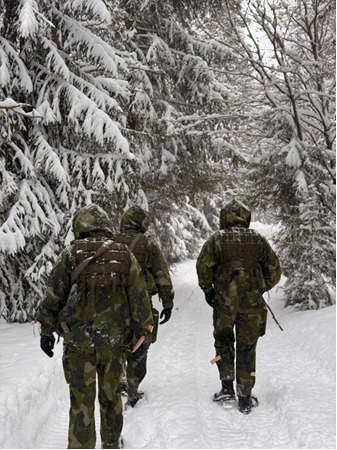
Dismounted Reconnaissance
FY25 Swedish CBRN Winter Course participants conduct small group dismounted reconnaissance.

Current CBRN TTPs require substantial modification for effective execution in extreme cold‑weather environments. During the Swedish winter course, the Swedes shared several of their existing detection methods—the Cone, Bag, and Bag & Hot Water methods—which underscore the challenges posed by the low volatility of chemical agents in extreme cold. The Cone Method, which isolates suspected agents to capture vapors, becomes cumbersome and time‑consuming. The Bag Method (mashing snow with M8 paper) and the Bag & Hot Water Method (requiring the transport and heating of water) introduce logistical complexity and further delay detection. All of these adapted methods are significantly more time‑consuming than standard procedures. Reduced off‑gassing of chemical agents, combined with potential obscuration by snow, drastically increased sampling frequency during dismounted reconnaissance—potentially tripling the number of stops required compared to standard TTPs. Therefore, a comprehensive review and update of existing TTPs and standard operating procedures (SOPs) is essential to incorporate specific guidelines for CBRN operations in extreme cold weather. Integrating cold‑weather considerations into all levels of CBRN training will enhance the Army’s overall readiness and effectiveness in Arctic operations.

Decontamination Challenges

Personnel Decontamination
Swedish conscripts conduct personnel decontamination.

Chemical decontamination processes are significantly less effective in cold weather. The Van't Hoff-Arrhenius theory indicates that an 18°F/10°C temperature decrease can reduce the rate of many chemical reactions by half, meaning that to achieve the same level of decontamination at lower temperatures, the contact time must be doubled. During the Swedish CBRN course, this theory was tested using the Reactive Skin Decontamination Lotion (RSDL). The results showed that RSDL neutralized the venomous agent X (VX) within seconds at room temperature, but at -15°C, it took over an hour to remove just 50% of the agent. Furthermore, RSDL can freeze at low temperatures, and the impact of freeze-thaw cycles on its effectiveness remains poorly understood. The traditional methods of decontamination become kinetically unfavorable in extreme cold-weather environments. To address these challenges, research into the temperature-dependent efficacy of our current decontaminants should drive the development and implementation of cold-weather-specific decontamination protocols such as mechanical removal, UV light, and the continued use of charcoal. Finally, training programs must be updated to specify cold-weather decontamination techniques.

Live-Agent Training
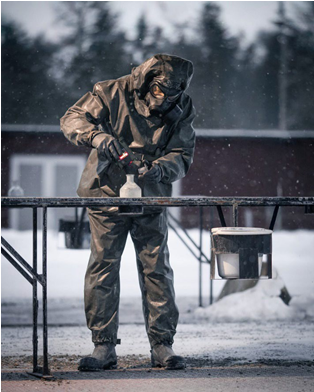
Live‑Agent Detection Training
Participants conduct live‑agent detection training.

The compromised functionality of CBRN detection equipment in temperatures below 0°F/-17°C requires careful selection and administration of training stimulants to accurately reflect physiological responses to live-agent exposure in extreme cold. For example, methyl salicylate can simulate the evaporation of mustard at room temperature, while bis-(3-chloropropyl) sulfide can be used to study mustard evaporation at 37°F/3°C.[5] Although stimulants offer reduced hazards and lower training costs, they may not fully replicate the urgency and realism of live-agent training. Proficiency in handling actual CBRN threats within realistic scenarios is unattainable through simulation alone. Therefore, increasing the frequency and scope of live-agent training exercises in extreme cold weather is highly encouraged to enhance CBRN-training effectiveness. Integrating live-agent training with the judicious use of appropriate simulants will create a comprehensive and realistic training program, equipping Soldiers with the skills and confidence necessary to operate effectively in extreme cold-weather CBRN environments.

Leadership and Training Emphasis

Physiological effect known as cocooning
Photo sourced from the Swedish Armed Forces Facebook page ‘CBRN Skolan,’ illustrating the physiological effect known as cocooning.

The legacy Field Manual 31‑70, Basic Cold Weather, states that “the leader selected to guide Soldiers in regions where extreme cold and rugged, trackless terrain make living and fighting far more difficult will face one of the greatest challenges of their lifetime.”[6] Effective leadership is paramount to ensuring troop readiness in such environments. Currently, outside of units routinely operating in extreme cold weather, the average Soldier lacks sufficient education and experience in essential cold-weather skills, including layered-clothing systems and basic cold-weather survival techniques. Therefore, leaders must thoroughly understand the principles of layered clothing and the physiological and psychological effects of cold weather. Commanders should require training that emphasizes the unique challenges of cold-weather operations—from planning considerations through execution.

Conclusion

The survivability and operational effectiveness of CBRN operations in extreme cold weather hinge on addressing critical gaps across multiple domains: technological advancements in cold-weatherized detection and decontamination equipment, the development of robust and realistic training programs incorporating both live-agent training and the effective use of simulants, and a renewed focus on leadership development that stresses cold-weather expertise. Ultimately, success in this demanding operational landscape depends not just on technological solutions but on a force that is mentally and physically resilient, equipped with the knowledge, skills, and leadership to navigate the complexities of challenges posed by extreme-cold conditions. The challenges are significant, but by embracing innovation, prioritizing training, and fostering strong leadership, the Chemical Corps can ensure that the Army remains ready and capable in even the most extreme environments.Army Chemical Review Watermark Crest

About the Authors

CW2 Vanessa C. Baker is currently the company warrant officer for 11th Chemical Company (TE), 110th Chemical Battalion, 48th Chemical Brigade. She holds an associate’s degree from Maryland Global Campus, Adelphi, Maryland.

CW2 Alejandra Gallego is currently the company warrant officer for 10th Chemical Company, 22d Chemical Battalion, 48th Chemical Brigade. She holds a bachelor’s degree in healthcare administration from University of Maryland Global Campus, Adelphi, Maryland.

Endnotes:

  1. U.S. Department of the Army, Army Training Publication (ATP) 3-90.96: Arctic and Extreme Cold Weather Operations (Washington, DC: Government Publishing Office, 2024). ↩
  2. Amnon Birenzvige, H. Yurow, and L. Parker, Tri-Service Workshop on Chemical Operations in Cold Weather, CRDEC-SP-019 (Hanover, NH: U.S. Army Cold Regions Research and Engineering Laboratory; Aberdeen Proving Ground, MD: Chemical Research, Development, and Engineering Center, 1990). ↩
  3. Birenzvige et al., Tri-Service Workshop on Chemical Operations in Cold Weather. ↩
  4. Birenzvige et al., Tri-Service Workshop on Chemical Operations in Cold Weather. ↩
  5. Birenzvige et al., Tri-Service Workshop on Chemical Operations in Cold Weather. ↩
  6. U.S. Department of the Army, Field Manual (FM) 31-70: Basic Cold Weather Manual (Washington, DC: Government Publishing Office, 1968). ↩

Disclaimer 1: The contents of this article do not represent the official views of, nor are they endorsed by, the U.S. Army, the Department of Defense, or the U.S. government.

Disclaimer 2: All photos in this article are property of the Swedish Armed Forces.

Download Original PDF Document
Published August 14, 2026
Share this page:

Army.mil

Army.mil


Employment

FOIA

Terms of Use

Accessibility/Section 508

Ready Army


Need Help? Try Army A-Z

My Army Benefits

Warriors Wanted Videos

Page Last Modified: 10/1/26, 1:48 PM

Army CID Submit a Tip / Report a Crime Logo

ManeuverSptCtrOfExce_nobackground.fw.png

Fort Leonard Wood


Policies and Regulations

MSCoE MEO and Garrison EEO

SHARP

Provide Feedback

Webmaster

PRIVACY


Community Resource Guide

https://www.usainscom.army.mil/isalute/iSalute - Report suspicious activity

imcom.army.mil

U.S. ARMY INSTALLATION MANAGEMENT COMMAND


"We Are the Army's Home"

FIND A GARRISON

Survivor Outreach Services | Total Army Sponsorship | Safety

Human Resources | Civilian Expeditionary Workforce

U.S. Army Environmental Command | Assistant Secretary of the Army for Installations, Energy & Environment

Back to Top