
 Family and Morale, Welfare & Recreation


Groundwater Treatment
RMA Groundwater Treatment: How it Works
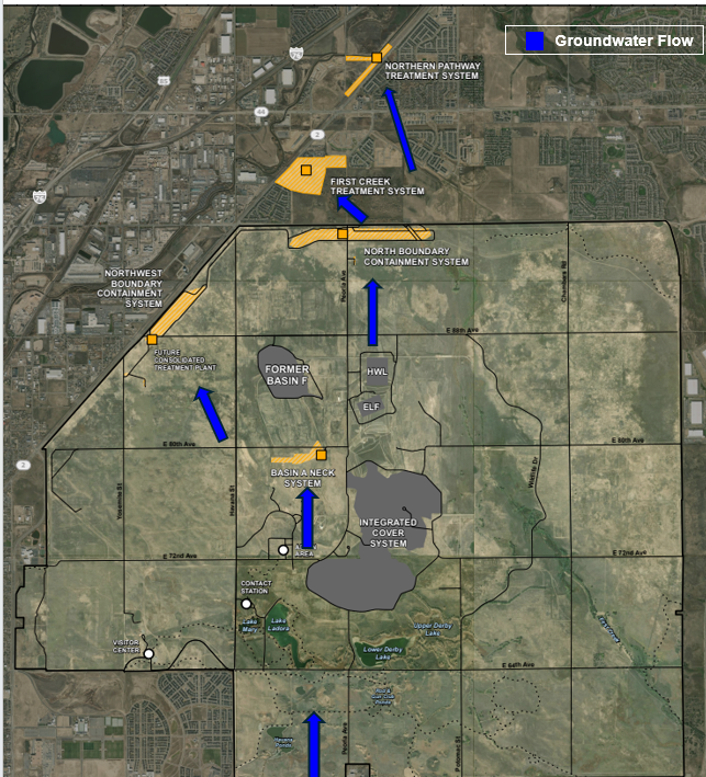 For nearly 50 years, the U.S. Army has been working to treat groundwater contamination at Rocky Mountain Arsenal — and to ensure that RMA water meets state and federal standards. The Army operates five groundwater treatment plants around the clock, under the oversight of the U.S. Environmental Protection Agency, the Colorado Department of Public Health and Environment, and Adams County Health Department. This page explains how the treatment program works — and how it is monitored to ensure it achieves RMA’s cleanup goals and protects public health and the environment.
Image Left: Map of Rocky Mountain Arsenal showing the natural flow of groundwater in a north or northwesterly direction as it flows off-site. Groundwater treatment facilities, which are positioned to intercept groundwater, are shown in orange.
From Manufacturing to Environmental Cleanup
Although the Army and Shell used accepted waste disposal methods of the time, RMA groundwater became contaminated during decades of military manufacturing and agricultural chemical production. The principal contaminants include pesticides, heavy metals, manufacturing by-products, and solvents.
In the 1970s, the Army constructed the first groundwater treatment plant to address contamination. The Army also paid to connect people living north and northwest of RMA to treated municipal water supplies. No residents use untreated groundwater that migrated off site before the treatment program began for their drinking water. (Instead of using treated municipal water, some residents choose to use wells that pump water from deeper, uncontaminated aquifers that lie below the shallow aquifer where RMA-related groundwater contamination may be present.)
Treatment Program Overview
The Army currently manages five on- and off-site groundwater treatment plants (shown on the map above in orange), which operate 24 hours a day, seven days a week. These facilities are positioned to intercept groundwater where it naturally flows.
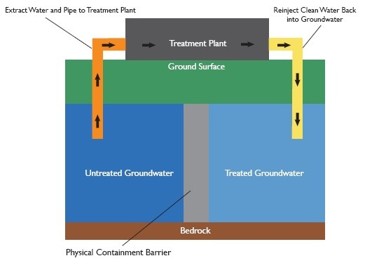 The illustration at the left shows how groundwater is treated. As untreated groundwater approaches the treatment plant, a long underground physical containment barrier stops it. Through a row of wells, water is extracted from the ground and then piped to a treatment plant, where it is treated to meet federal and state water standards. The treated water is then piped to recharge trenches—a system of piping and gravel that reinjects treated water back into the ground on the downstream side of the physical containment barrier.
The Army also maintains a network of monitoring wells, which are used to collect groundwater samples to ensure the treatment program is working as designed. Groundwater monitoring and treatment will continue until all groundwater at the site meets state and federal standards.
Groundwater Treatment Approaches
RMA uses several different approaches for removing groundwater contaminants. All RMA treatment plants use carbon adsorption, which is also used by most municipal water treatment facilities. At some RMA treatment plants, additional processes are used to treat contaminants that are not effectively treated by carbon adsorption alone.
Here are the primary treatment approaches used at RMA:
Carbon Adsorption
Carbon adsorption is a water treatment method that uses a special material called activated carbon to remove harmful compounds from groundwater. Activated carbon works like a sponge — its rough, porous surface catches contaminants as water passes through it. This method is commonly used to remove chemicals like pesticides, industrial solvents, and other pollutants.

Air Stripping
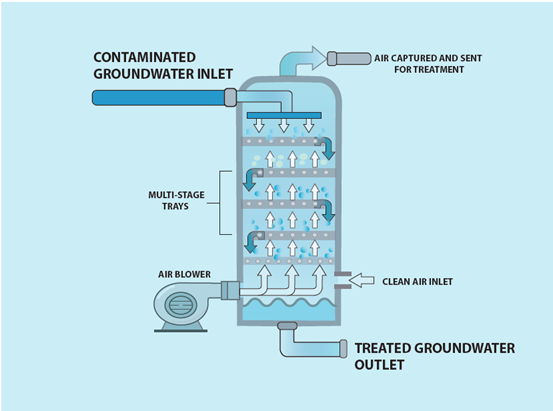
Air stripping is a process for removing chemicals from groundwater by exposing the water to large currents of moving air. Contaminated water is pumped out of the ground and passed through a stacked tower, where it trickles down over trays while fresh air is blown upward through the tower. As the water and air meet, the harmful chemicals — mostly solvents and other compounds that evaporate easily — transfer from the water into the air, where they are captured and treated separately using carbon adsorption. The cleaned water is then collected at the bottom of the tower and can be safely reinjected into the ground or sent on to a second treatment process within the facility. The air stripper process is currently in use at the Basin A Neck Treatment System.
UV Filtration
Ultraviolet (UV) filtration cleans water by shining an intense ultraviolet light through it. This light is invisible to the human eye, but it is powerful enough to break down the chemical bonds in many contaminants, including manufacturing byproducts, solvents, and organic compounds. It does not add chemicals to the water, making it a clean and efficient option for treating groundwater. The UV filtration process is currently used at the North Boundary Containment System.

COMING SOON: AOP (Advanced Oxidation Processes)
An emerging contaminant, 1,4-Dioxane, was recently added as a contaminant to be treated at RMA. 1,4-Dioxane is not effectively treated by carbon adsorption alone. As a result, UV Light/Advanced Oxidation Processes (AOP) will be used to supplement carbon adsorption where needed.
The Advanced Oxidation Process uses ultraviolet light and hydrogen peroxide — the same chemical found in many medicine cabinets — to clean contaminated groundwater. When UV light hits hydrogen peroxide, it creates highly reactive particles that rapidly break down harmful pollutants into harmless byproducts such as carbon dioxide and water. AOP is especially effective against contaminants, such as 1,4-Dioxane, that resist other treatment methods.

Duration and Progress
Groundwater treatment will likely take several decades to complete. Why so long? Unlike surface water, groundwater seeps much more slowly through underground soil and rock. At RMA, for instance, some groundwater pathways can take 40 years or more to reach a treatment plant. In addition, some contaminants cling to underground soils and dissolve only gradually into the water as it moves toward treatment facilities. Together, these factors explain why reaching the Army's cleanup goals is a long-term commitment.
To monitor progress and ensure cleanup goals are being met, the Army operates and maintains an ongoing groundwater monitoring program in cooperation with the regulatory agencies. The results are published in reports that are available to the public online here.