


The Protection Branch includes the Emergency Management Office and Antiterrorism Office, and is responsible for planning, preparing, and coordinating operational, emergency, disaster, and antiterrorism/force protection actions for the installation and assigned mission and tenant units. It coordinates all-hazards emergency management preparedness, training, and exercises with installation and bilateral partners, and manages the Emergency Operations Center (EOC).
USAG Japan Key Phone Numbers
USAG-J Base Directory: 046-407-1110
USAG-J Civil Emergency Management / EOC: 046-407-4560
USAG-J Fire Department: 046-407-3344
USAG-J Military Police Desk: 046-407-3002
USAG-J Directorate of Public Works: 046-407-4613
Camp Zama Self Help: 046-407-4639
SHA Self Help: 046-407-6150
USAG-J Public Affairs: 046-407-4388
USAG Japan communication tools
USAG-J Facebook: https://www.facebook.com/USAGJ
USAG-J X: https://x.com/usagjapan
Email: usag.japan@gmail.com
MAPA My Army Post App: Click for Info
Command Channel: Channel 37-20 on-post
USAG Japan reporting options
Base Closure: USAG Japan is closed to all operations except emergency launches, recoveries and mobilization training. Only designated Emergency Employees who are required to maintain essential base services and activities will report to duty.
Limited Operations: USAG Japan is open for limited operations. Only designated Emergency Employees are required to report for duty to maintain and support limited operations and prepare the USAG Japan for full operations.
Delayed Reporting: Designated Emergency Employees should report to work as scheduled and exercise extreme caution when reporting. Non-Emergency Employees will report to work at the time designated. Additional delays may be directed by mission partner commanders/directors due to road hazards and/or safety concerns.
Early Departure: Designated Emergency Employees will remain at work pending unit guidance. Non Emergency Employees will be notified of specific departure times. Mission partners are responsible for managing early release for all personnel within their organization when the USAG Japan commander initiates early release. The goal is to stagger departure times to alleviate congestion.
Typhoon Preparedness
Each year, about 30 typhoons form over the Northwest Pacific Ocean, and approximately 11 cross over Japan. Most typhoons make landfall between May and October, with August and September being the peak season.
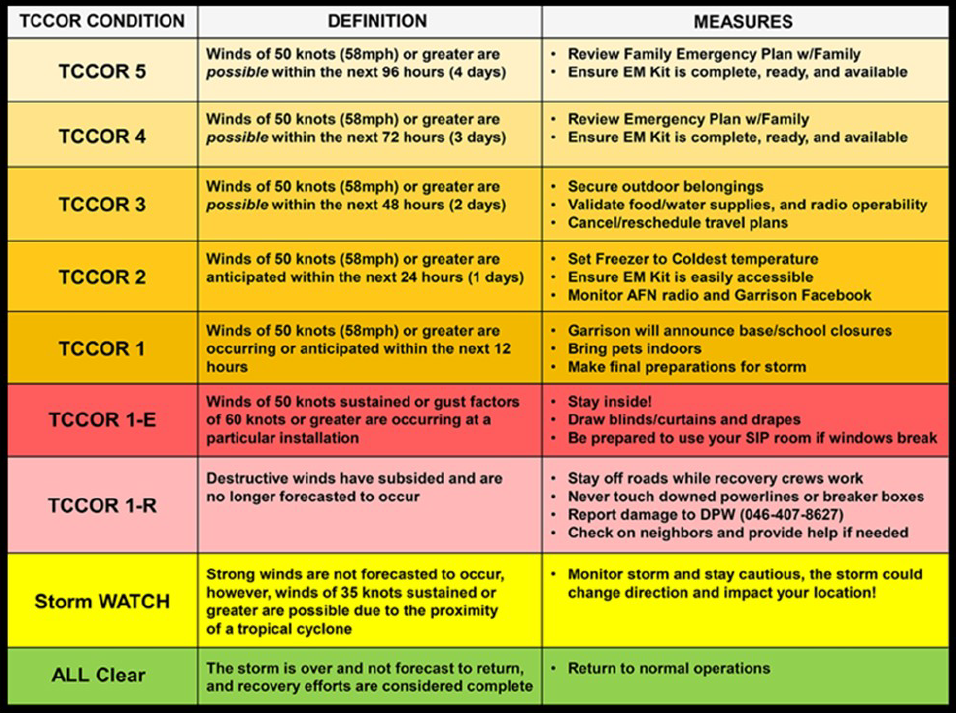
In order to ensure you and your family are prepared, it’s important that you integrate “Ready Army” into your routine. Ready Army is the Army’s proactive community awareness campaign to empower Soldiers, their Families and Army Civilians to prepare for all hazard emergencies through four steps. Be Informed; Make a Plan; Build a Kit and Get Involved. Take this time to update your Emergency Kit, Family Communication Plan, and become knowledgeable of the differences in TCCOR (Tropical Cyclone Conditions of Readiness) levels.
Before a Typhoon
General Actions
- Fuel up vehicle(s)
- Know where to find the closest safe havens/local shelters
- Charge electronic devices
- Secure important documents
- Fill up your bathtub (Non-Potable water)
- Put refrigerator(s) and freezer(s) on highest setting and limit opening
- Check your Emergency Supply kits and your family communication plan
Hazard Specific Actions
Wind:
- Reinforce or strengthen the building including doors, windows, walls, and roofs.
- Discard and/or secure loose, lightweight ob-jects (e.g., patio furniture, garbage cans, and bicycles).
- Anchor heavy/large objects or those that would be unsafe to bring inside (e.g., gas grills and propane tanks); and trim or remove trees close enough to fall on buildings.
Flood:
- Keep gutters and drains free of debris.
- Purchase insurance (that covers flooding).
After a Typhoon
- Wait for the All Clear.
- Do not wade in floodwaters which can contain dangerous debris like broken glass, metal, dead animals, sewage, gasoline, oil, and downed power lines.
- Do not enter a building until it has been inspected for damage to the electrical system, gas lines, sewer and water lines.
- Wear appropriate protective equipment such as gloves, safety glasses, rubber boots, and masks to protect yourself from debris and airborne particles, e.g., mold and dust.
- Do not use electrical equipment if it is wet or if you are standing in water.
- Throw out any food including canned items that were not maintained at a proper temperature or have been exposed to floodwaters.
- Do not eat food from a flooded garden. When in doubt, throw it out.
- Avoid drinking tap water until you know it is safe. If uncertain, boil or purify it first.
- Clean and disinfect everything that got wet. Mud left from floodwater can contain sewage, bacteria, and chemicals.
Post-Typhoon Clean-up
- AIR OUT by opening all doors and windows whenever you are present. Leave as many windows open when you are not present as security concerns allow.
- MOVE OUT saturated porous materials such as mattresses or upholstered items, especial-ly those with visible fungal growth.
- TEAR OUT flooring, paneling, drywall, insula-tion, and electrical outlets saturated by flood-water. (HOME OWNERS ONLY)
- CLEAN OUT and disinfect any remaining de-bris and mud.
- DRY OUT the building and any remaining con-tents.
Links
- iWatch - USAGJ iWatch
- Ready.gov - https://www.ready.gov
- Ready Army - https://www.army.mil/ready
- American Red Cross-https://www.redcross.org