


LTC Brandon E. Pasko
Battalion Commander

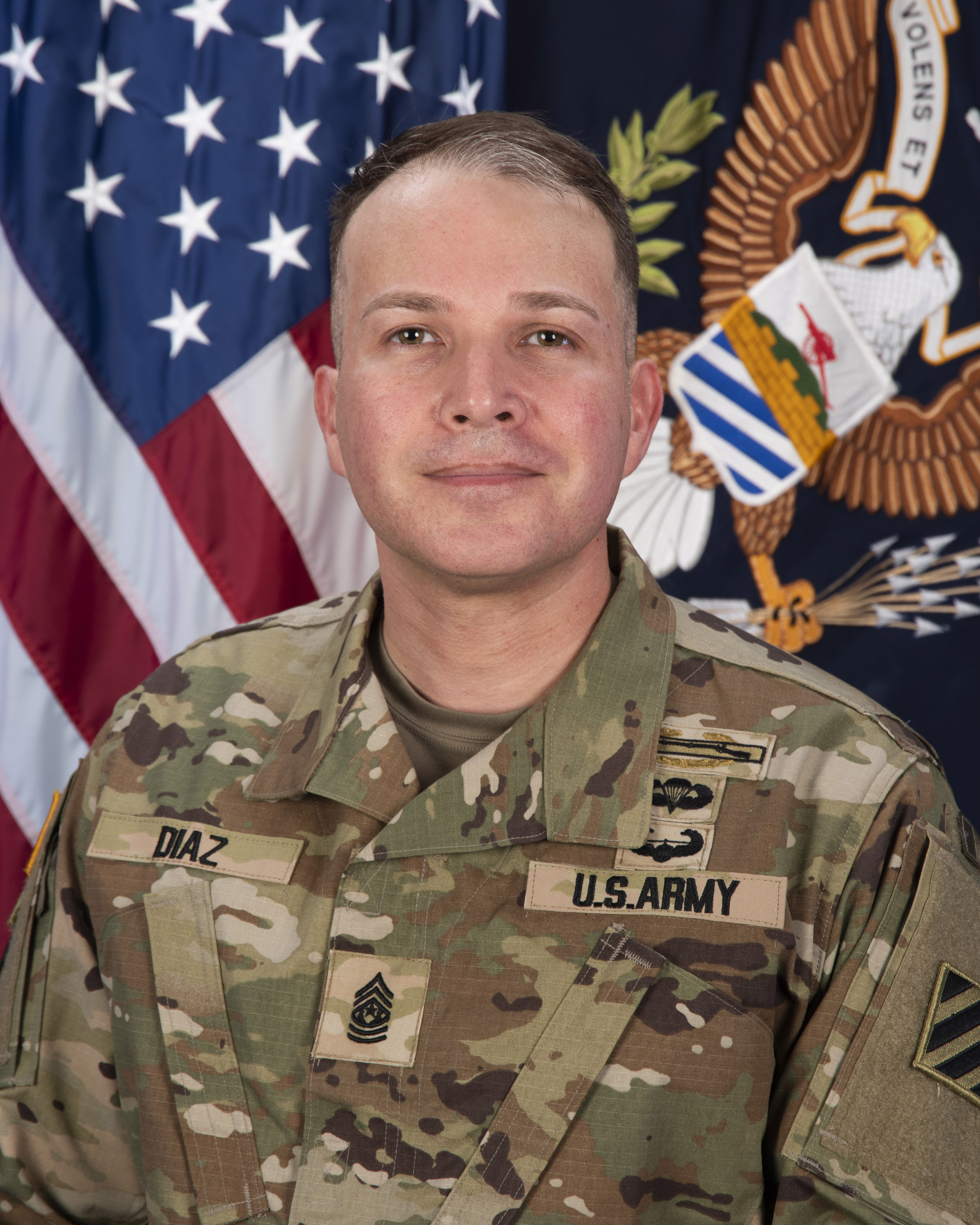
CSM Luis A. Diaz
Command Sergeant Major
Biography unavialable
The 2nd Battalion, 7th Infantry Regiment, famously known as the "Cottonbalers," is one of the oldest and most decorated combat units in the United States Army. As a subordinate unit of the 1st Armored Brigade Combat Team, 3rd Infantry Division, the battalion has participated in almost every major conflict in American history since its inception.
Operating with the motto Volens et Potens (Willing and Able), the Cottonbalers boast an impressive lineage adorned with 68 campaign streamers and numerous unit citations.
The 7th Infantry Regiment was initially constituted in the Regular Army in January 1812 in preparation for the War of 1812 against Great Britain. The regiment etched its name into history during the Battle of New Orleans in January 1815. Serving under General Andrew Jackson, the soldiers stubbornly held their defensive lines behind improvised breastworks constructed out of cotton bales, successfully repelling the British attack. This ingenious defensive strategy earned the regiment its enduring nickname, "The Cottonbalers," a moniker they carry with immense pride to this day as they maintain their combat readiness.
Throughout the 19th century, the Cottonbalers saw extensive service across the expanding United States. This included critical actions in the Mexican-American War from 1846 to 1848, where they fought at major battles like Vera Cruz, Cerro Gordo, and Chapultepec.
During the American Civil War, the regiment was assigned to the Army of the Potomac and participated in brutal engagements such as Fredericksburg and Chancellorsville. At the Battle of Gettysburg in July 1863, the Cottonbalers valiantly advanced across Plum Run toward the Wheatfield. Despite suffering over 50 percent casualties from heavy, multi-directional fire, the regiment managed to withdraw to the safety of Little Round Top, earning tremendous respect for their resilience.
When the United States entered World War I, the 7th Infantry Regiment was integrated into the newly formed 3rd Infantry Division. They fought ferociously in France, participating in the Aisne, Château-Thierry, and Champagne-Marne campaigns. Their extraordinary defense of the Marne River earned the regiment the French Croix de Guerre with Star, demonstrating their unyielding combat effectiveness.
During World War II, the Cottonbalers proved instrumental across multiple theaters.
Beginning with the invasion of North Africa in 1942, they fought their way through Sicily, up the Italian peninsula, and eventually into Southern France and Germany. Notably, Staff Sergeant Stanley Bender of Company E, 2nd Battalion, 7th Infantry, earned the Medal of Honor for his heroic assault on a German machine gun roadblock near La Lande in southern France in August 1944. The regiment fought continuously until reaching Berchtesgaden at the war's conclusion.
The 7th Infantry Regiment deployed to Korea in late 1950, landing at Wonsan/Iwon. Known as the "Fire Brigade" for their rapid-response capability, the regiment was immediately thrust into a theater of severe crisis. During the freezing winter of 1950, elements of the unit were rapidly integrated into Task Force Dog. They advanced to Chinhung-ni to relieve a Marine battalion, establishing a vital protective rear-guard that secured the withdrawal of the embattled 1st Marine Division from the Chosin Reservoir.
Following this brutal retreat, the "Cottonbalers" fell back to defend the vital coastal port of Hungnam. Facing relentless Chinese assaults, they held a heavily contested defensive line through fierce hand-to-hand combat to protect fleeing UN troops and civilian refugees. Highlighting their tenacity, the 7th Infantry was the very last unit to board the evacuation transports before the port was destroyed on December 24, 1950.
For the remainder of the war, the regiment fought continuously in the Chorwon-Kumwha area, defended the critical Arrowhead outposts, fought at Jackson Heights, and ultimately blocked a massive Chinese offensive at Kumsong in 1953. Their valor earned them multiple Republic of Korea Presidential Unit Citations for actions in the Iron Triangle and Uijongbu Corridor.
After the Korean War, the 2nd Battalion transitioned into a heavy mechanized infantry force stationed in West Germany, serving as a critical deterrent against Soviet aggression. Stationed primarily in Aschaffenburg alongside other elements of the 3rd Infantry Division's 3rd Brigade, the Cottonbalers maintained a constant, high-alert readiness posture to defend strategic corridors like the Fulda Gap.
The unit literally stood on the frontlines of Cold War geopolitical tension. In August 1961, just days after the Soviet Union abruptly erected the Berlin Wall, a reinforced company from the 7th Infantry Regiment was thrust into a highly volatile situation. Ordered to travel the Autobahn from Aschaffenburg directly into West Berlin in full combat gear, the unit acted as a strategic test of resolve. The objective was to assert the United States' unhindered right of free passage through East Germany, not knowing if East German or Soviet forces would attempt to impede or attack the US troops. The unit arrived in West Berlin successfully without incident, confirming the right of free passage and sending a powerful deterrent message.
For decades, the battalion continuously honed its armored warfare tactics, heavily patrolling the Czechoslovakian border with Germany. Through intensive gunnery cycles and massive REFORGER field exercises, the 2nd Battalion, 7th Infantry served as an unyielding NATO bulwark until the eventual draw-down of forces following the collapse of the Soviet Union, ultimately departing Aschaffenburg and closing Fiori Kaserne in the summer of 1992 .
In recent decades, the 2nd Battalion, 7th Infantry has transitioned into a highly modernized heavy mechanized infantry force. The Cottonbalers participated in Operation Desert Storm in 1991 as part of the 24th Infantry Division, helping to rapidly liberate Kuwait.
Reassigned to the 3rd Infantry Division, Task Force 2-7 spearheaded the invasion of Iraq during Operation Iraqi Freedom in 2003. They victoriously led the attack into Baghdad International Airport during the initial offensive assault.
Through four subsequent, grueling combat tours in Iraq—operating in key locations like Tikrit and the restive Al Anbar province—and deployments to Afghanistan for Operation Enduring Freedom, the 2nd Battalion, 7th Infantry continues to uphold its legacy of courageous frontline service.
In response to heightened geopolitical instability and Russia’s full-scale invasion of Ukraine, the 2nd Battalion, 7th Infantry Regiment ("Cottonbalers") has played a critical role in reinforcing NATO’s Eastern Flank. Operating as part of the 1st Armored Brigade Combat Team, 3rd Infantry Division, the battalion deployed to Eastern Europe under Operation Assure, Deter, and Reinforce to project a combat-credible deterrent against regional aggression. There the Cottonbalers serve as a vital pillar of V Corps' forward-deployed combat power. By conducting joint exercises such as Polish Dragon, Allied Spirit, and Winter Camp in Estonia, the unit refines tactical maneuvers alongside multinational NATO battlegroups. These grueling field exercises tested combined-arms breaching, cold-weather warfare, and rapid armored repositioning through the highly sensitive Baltic Corridor.
2-7 INFANTRY BATTALION (1ABCT)
Primary: 571-801-2175

| Sunday | 24/7 |
| Monday | 24/7 |
| Tuesday | 24/7 |
| Wednesday | 24/7 |
| Thursday | 24/7 |
| Friday | 24/7 |
| Saturday | 24/7 |
BLDG 643
643 Gulick Ave
Fort Stewart GA 31314