


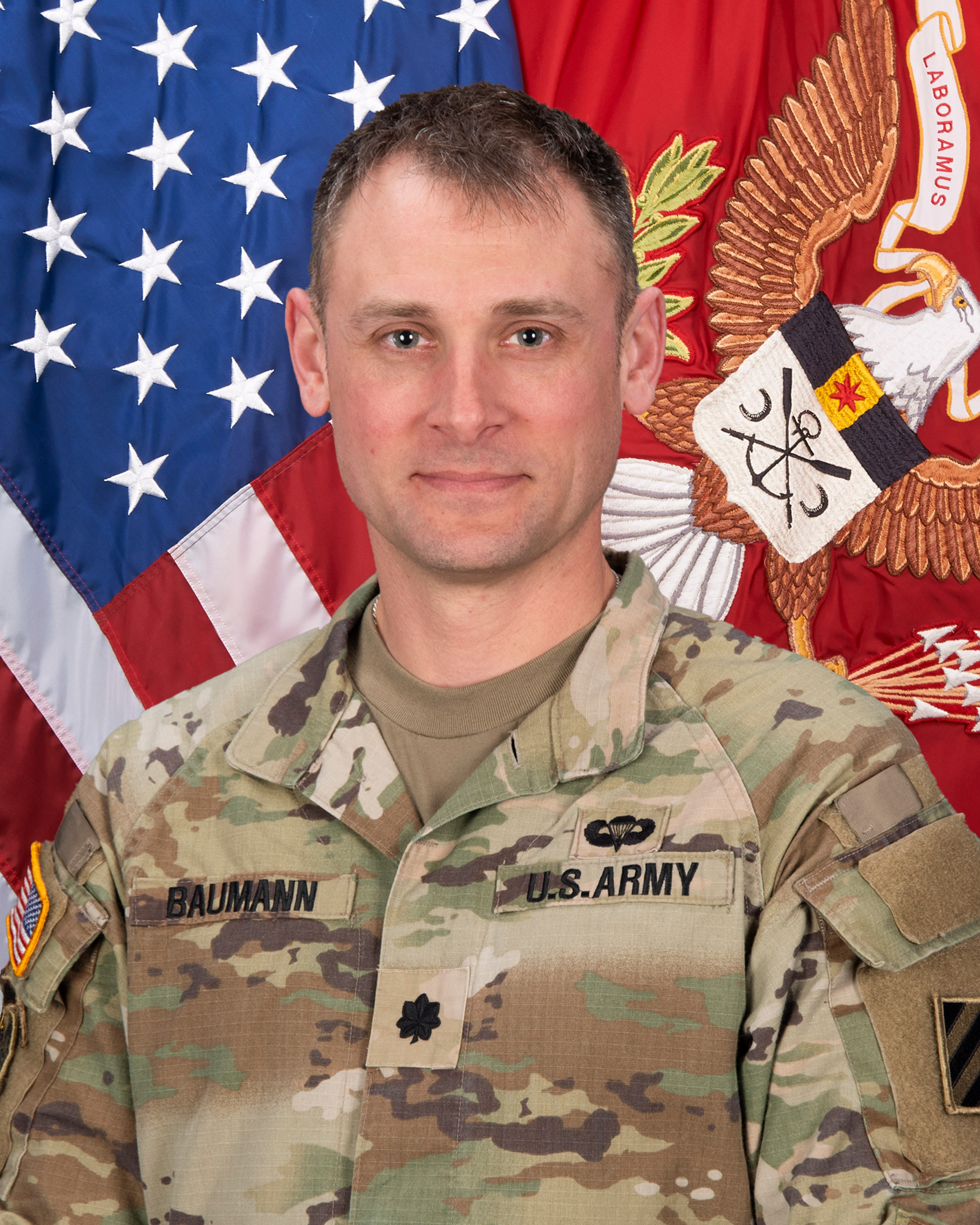
LTC Joseph M. Baumann
Battalion Commander

Welcome Letter

CSM Russell Hull
Senior Enlisted Leader
The 10th Engineer Battalion, known by its enduring motto Laboramus Sustinere (Latin for "We Work to Assist"), holds one of the longest and most distinguished lineages in the United States Army Corps of Engineers. Currently serving as the 10th Brigade Engineer Battalion (10th BEB) assigned to the 1st Armored Brigade Combat Team (1ABCT), 3rd Infantry Division at Fort Stewart, Georgia, the battalion has cleared the path for American infantry and armor in nearly every major conflict since the American Civil War.
The battalion traces its origins to December 31, 1861, when it was constituted in the Regular Army as a provisional engineer battalion during the early months of the American Civil War. Operating in the dense wilderness and muddy terrains of the eastern theater, these early combat engineers supported the Union Army through historic campaigns, including Antietam, Fredericksburg, and the brutal Siege of Petersburg, before witnessing the Confederate surrender at Appomattox.
When the United States entered World War I, the legacy of the battalion continued as part of the 6th Engineers, which was assigned to the newly formed 3rd Division in October 1917. The combat engineers proved their mettle during the ferocious Second Battle of the Marne, supporting the American Expeditionary Forces with vital river-crossing operations and bridge-building.
Their extraordinary actions during the Aisne-Marne and Champagne-Marne campaigns earned the unit the prestigious French Croix de Guerre with Palm. In 1939, the 6th Engineers were reorganized, and its 2nd Battalion was officially redesignated as the 10th Engineer Battalion, firmly cementing its place as a permanent element of the 3rd Infantry Division.
During World War II, the 10th Engineer Combat Battalion was essential to the 3rd Infantry Division’s rapid and highly lethal amphibious assaults. The combat engineers spearheaded the landings in North Africa, Sicily, and the bloody beaches of Anzio, Italy.
Operating constantly under enemy fire, the battalion cleared minefields, blew anti-tank obstacles, and built critical Bailey bridges to keep the division's mechanized assets rolling forward into Central Europe.
In the winter of 1944–1945, the battalion fought in the freezing conditions of the Colmar Pocket in France. Braving sub-zero temperatures and intense German artillery, the 10th Engineers successfully bridged freezing rivers, enabling the Allied armor to crush the German defensive perimeter. This heroic effort earned the battalion the Presidential Unit Citation and another French Croix de Guerre.
When the 3rd Infantry Division deployed to the Korean War, the 10th Engineer Battalion faced a harsh, unforgiving operational environment. During the freezing winter of 1950, the battalion provided critical infrastructure and defensive support as UN forces executed their fighting withdrawal from the Chosin Reservoir to the port of Hungnam.
The engineers operated concertina wire factories, built expedient bridges over the Imjin River, and carved roads out of the freezing mountains to keep supply lines open for front-line infantry.
Throughout the conflict, their support in heavily contested sectors like the Uijongbu Corridor and the Iron Triangle earned the unit two Republic of Korea Presidential Unit Citations and the Chryssoun Aristion Andrias (Bravery Gold Medal of Greece).
During Operation Desert Sheild/Storm in 1991, the 10th Engineer Battalion deployed to Southwest Asia, serving a critical role in the rapid, overwhelming Allied ground offensive against Iraqi forces. Operating in the harsh desert environments of Saudi Arabia, Kuwait, and Iraq, the battalion's combat engineers were heavily relied upon to ensure the mobility and survivability of coalition armored forces.
Working under the operational umbrella of the 3rd Infantry Division—whose 3rd Brigade was attached to the 1st Armored Division for the massive "Left Hook" maneuver—the 10th Engineers cleared complex Iraqi minefields, reduced anti-tank berms, and neutralized unexploded ordnance. Their direct combat support was essential during major engagements, including the decisive Battle of Medina Ridge, one of the largest tank battles in U.S. history. By maintaining the rapid tempo of the armored thrust, the 10th Engineer Battalion proudly upheld its motto, Laboramus Sustinere ("We Work to Assist"), cementing its legacy of combat-credible engineering.
Following service in Operation Desert Storm During Operation Desert Sheild/Storm in 1991, the 10th Engineer Battalion deployed to Southwest Asia, serving a critical role in the rapid, overwhelming Allied ground offensive against Iraqi forces. Operating in the harsh desert environments of Saudi Arabia, Kuwait, and Iraq, the battalion's combat engineers were heavily relied upon to ensure the mobility and survivability of coalition armored forces.
Working under the operational umbrella of the 3rd Infantry Division—whose 3rd Brigade was attached to the 1st Armored Division for the massive "Left Hook" maneuver—the 10th Engineers cleared complex Iraqi minefields, reduced anti-tank berms, and neutralized unexploded ordnance. Their direct combat support was essential during major engagements, including the decisive Battle of Medina Ridge, one of the largest tank battles in U.S. history. By maintaining the rapid tempo of the armored thrust, the 10th Engineer Battalion proudly upheld its motto, Laboramus Sustinere ("We Work to Assist"), cementing its legacy of combat-credible engineering.
The 10th Engineer battalion was heavily tested during Operation Iraqi Freedom in 2003.
As part of the 3rd Infantry Division's rapid armored thrust from Kuwait to Baghdad, the 10th Engineer Battalion cleared routes of improvised explosive devices and breached massive defensive berms. Their flawless execution in facilitating the collapse of the Iraqi regime earned the battalion another Presidential Unit Citation.
Inactivated in 2004, the unit was proudly reactivated in 2015 as the 10th Brigade Engineer Battalion (10th BEB) under the 1ABCT, 3rd Infantry Division.
Today, the battalion continues to innovate on the modern battlefield. From constructing massive survivability positions for M1A2 Abrams tanks with D7 dozers to testing purpose-built First-Person View (FPV) drones for advanced reconnaissance during NATO exercises in Germany, the 10th BEB remains at the cutting edge of combat engineering.
Whether breaching complex obstacles or defending global security on the Eastern Flank, they continue to prove that they Work to Assist, leading the charge for the armored forces of the United States
The 10th Engineer Battalion began using their famous nickname and unofficial motto, "Bridge the Sky" (often referred to as "We Bridged the Sky"), following an extraordinary feat of combat engineering on August 13, 1943, during the Allied invasion of Sicily (Operation Husky). During the Battle of Cape Calava, August 1943: Allied push toward Messina, Sicily, General Patton’s 3rd Infantry Division was racing along the northern coastal highway to beat the British Eighth Army under General Montgomery.
As the German forces retreated, they detonated a demolition charge on a stretch of Highway 113 at Cape Calava, destroying a 150-foot section of the road that wrapped around a sheer, vertical cliff rising directly out of the Mediterranean Sea. The gap was designed to halt Patton's armor and infantry indefinitely.
Faced with this massive, seemingly impassable obstacle, Patton ordered the 10th Engineer Combat Battalion to clear the way. The challenge was a cliffside dropped off directly into the sea below, meaning there was no solid ground to build a standard bypass or fill the gap. The unit’s solution was working tirelessly under the cover of darkness, the combat engineers designed and constructed a wooden trestle bridge that literally hung off the side of the cliff, anchored into the rock face. Suspended high above the crashing ocean, the engineers completed the construction of this legendary "bridge in the sky" in just 24 hours.
The completion of this bridge on August 13, 1943, allowed the 3rd Infantry Division’s tanks, artillery, and infantry to safely cross the gap and continue their rapid advance. Thanks to the 10th Engineers, the division arrived in Messina hours before Montgomery’s British forces, securing a major strategic victory for the U.S. Army. This historic, gravity-defying achievement permanently earned the battalion their iconic nickname: "We Bridged the Sky"
10TH ENGINEER BATTALION (1ABCT)
Primary: 571-801-0759

| Sunday | 24/7 |
| Monday | 24/7 |
| Tuesday | 24/7 |
| Wednesday | 24/7 |
| Thursday | 24/7 |
| Friday | 24/7 |
| Saturday | 24/7 |
BLDG 525
804 Wilson Ave
Fort Stewart GA 31314